Archives For November 30, 1999

Greenpeace last week released the results of its third-annual green electronics survey – a look at how leading electronics manufacturers companies are doing. All but Apple and Phillips of the 21 companies contacted agreed to be ranked on three criteria; removing toxic substances, responsible take-back of their end-of-life products and energy efficiency.

The survey was motivated by the fact that throughout a product’s lifecycle – from material extraction to production, and from consumer use to disposal – electronic products have the potential to impact human health and the environment through the release of dangerous substances and energy consumption.

China is the world center for processing IT products and that country’s environment is paying the price. Printed Circuit Board and battery power production especially create heavy metal pollution.

Part of the problem is consumer demand for cheap products that don’t reflect the true cost of production – they don’t reflect the toll on the environment, on public and worker health.

Furthermore, IT companies continue to produce goods that have obsolescence built in, which means we consume endlessly looking for the newest or better product, boosting company revenues but at huge environmental and social cost, that, again, is not reflected in the price we pay.

The Greenpeace survey found a general improvement in green features compared to the previous two surveys in 2008 and 2007, including a significant decrease in use of hazardous chemicals and almost all products met or exceeded energy efficiency standards.

But lifecycle management was still the weakest point, with very little use of recycled plastic, varying take-back practices and few marketing efforts to prevent fast obsolescence of products.

Generally, also, Greenpeace found that electronics companies were becoming more transparent in the amount and type of product information provided to customers, often listing product’s chemical make-up and performance details.

Apple and Philips, however, once again refused to disclose any information to Greenpeace. Of course this reluctance to provide information is disappointing and not limited to probing by Greenpeace.

Beijing-based IPE, led by environmental activist Ma Jun, has also over the past year focused on the IT sector for its significant contribution to environmental degradation in China.

IPE has also contacted electronics companies about environmental violations and Apple is among those refusing to address questions about noxious emissions by factories producing its products.

Writing in a Guardian blog earlier last year, Ma Jun said 34 Chinese environmental organizations, including Friends of Nature, the Institute of Public and Environmental Affairs, and Green Beagle, questioned heavy metal pollution produced by companies in Apple’s supply chain in a letter sent to CEO Steve Jobs. Last week Ma Jun said that the only response from Apple has been a demand for proof that the polluting factories are producing electronics for Apple.

“The links between these companies and Apple are clearly established,” Ma Jun said last week. “We are working now to provide the company with hard evidence. Their unwillingness to release information about their production processes reminds me of Nike in the 1990s,”

By contrast, in an interview with Asia Water Project last year Ma Jun praised Hewlett Packard and Samsung for duck disclosure and movement toward greener products. Indeed, HP and Samsung were among the companies singled out in the Greenpeace survey for the producing some of the greenest products.

Why single out Apple, as IPE has done? Does a company with a solid reputation for being on top of its game, for producing innovative, quality and well-designed products, have a responsibility to manufacture without excessive environmental and social cost? Shouldn’t Apple be a leader also in its production processes and not a laggard?  Should we as consumers not demand more from the companies that sell us our products?

Fortunately, consumers ARE beginning to taking note. Companies that fail to adapt are poised to suffer huge reputational and revenue losses as a consequence.  A game-changing opportunity awaits those companies that choose to meet this challenge.


The world’s problems are too vast for philanthropy or governments alone to solve. The US$300 billion spent by U.S. philanthropists last year is just not enough to make a significant dent, while foreign aid represents less than 1 percent of global gross domestic product.

The reality is that only by harnessing the markets, large-scale private and institutional capital, will we even begin to meet the challenges posed by massive population growth, meet our many needs, address issues around water scarcity, our depleted resources as well as our polluted air and water.

Philanthropy can help spur innovation, it can be used as risk capital, to develop models for social benefit that can then be scaled. Governments can help take that innovation to scale but they can’t do it all. Only markets have the potential to bring about real change at the scale and speed we need that to happen.

In other words, we urgently need to take social investments out of the realm of just doing good and plant them firmly in business models in order to make our world fit for our children and grandchildren.

But how does that happen?

A new report released last week by J.P. Morgan and the Rockefeller Foundation in partnership with the Global Impact Investing Network  (GIIN) attempts to advance this discussion.

The report argues that impact investments are emerging as an alternative asset class, thus allowing the sector to be considered alongside any other as part of an investment portfolio.  Impact investments in this instance are defined as investments intended to create positive impact beyond, although not to the exclusion of, a financial return.

“With increasing numbers of investors rejecting the notion that they face a binary choice between investing for maximum risk-adjusted returns or donating for social purpose, the impact investment market is now at a significant turning point as it enters the mainstream, ” the report states.

It addresses questions such as what defines and differentiates impact investments, who is involved in the market and how they allocate capital. Also considered is what makes impact investment an emerging asset class, how much return investors are expecting and receiving,  how large is the potential opportunity for investment in this market and what does risk management and social monitoring involve?

The report analyzes five sectors that serve bottom-of-the-pyramid populations (the global population earning less than US$3,000 annually): Urban affordable housing, rural access to clean water, maternal health, primary education, and microfinance.

For just these segments of the impact investing universe, the report identifies a potential profit opportunity of between $183 and $667 billion as well as  investment opportunity between $400 billion and $1 trillion over the next decade.

Many impact investments will take the form of private equity or debt investments, the report says, while other instruments can include guarantees or deposits.  Publicly listed impact investments do exist, although as a small proportion of transactions.

B-Lab differentiates Impact Investing and Socially Responsible Investing, which has been around for some time, defining SRI (estimated at $2.7 trillion in 2007) as primarily negative screening, or investment in screened public equity funds that avoid so-called ‘sin stocks’ or seek to influence corporate behavior.

The core of the II asset class is that the model of the business (which could be a fund management firm or a company) into which the investment is made should be designed with the intent to achieve positive social or environmental impact, and this should be explicitly specified in company documents.

There are a handful of investment funds established to finance businesses that address social problems, especially in the developing world. Examples of funds working in these space include Acumen Fund, Root Capital, E+Co and IGNIA, among others.

A significant challenge identified in making impact investments is sourcing transactions. Many impact investment recipients are small companies and the majority of deal sizes analyzed from our investor survey are less than US$1m.

Particularly for investors based in different regions, the costs of due diligence on these investments can often challenge the economics of making such small investments.

Another, of course, would be setting the reporting standards needed to establish just what constitutes a social or environmental return on an investment. This is something on which GIIN and B-Lab are working hard.

It’s great to see a mainstream financial institution dipping into this discussion.

Last week,  I participated in a panel discussion at INSEAD, Singapore on impact investing and many of the points above were discussed at length. In particular, we spoke of the  challenges of II in a developing world context where this is urgently needed.


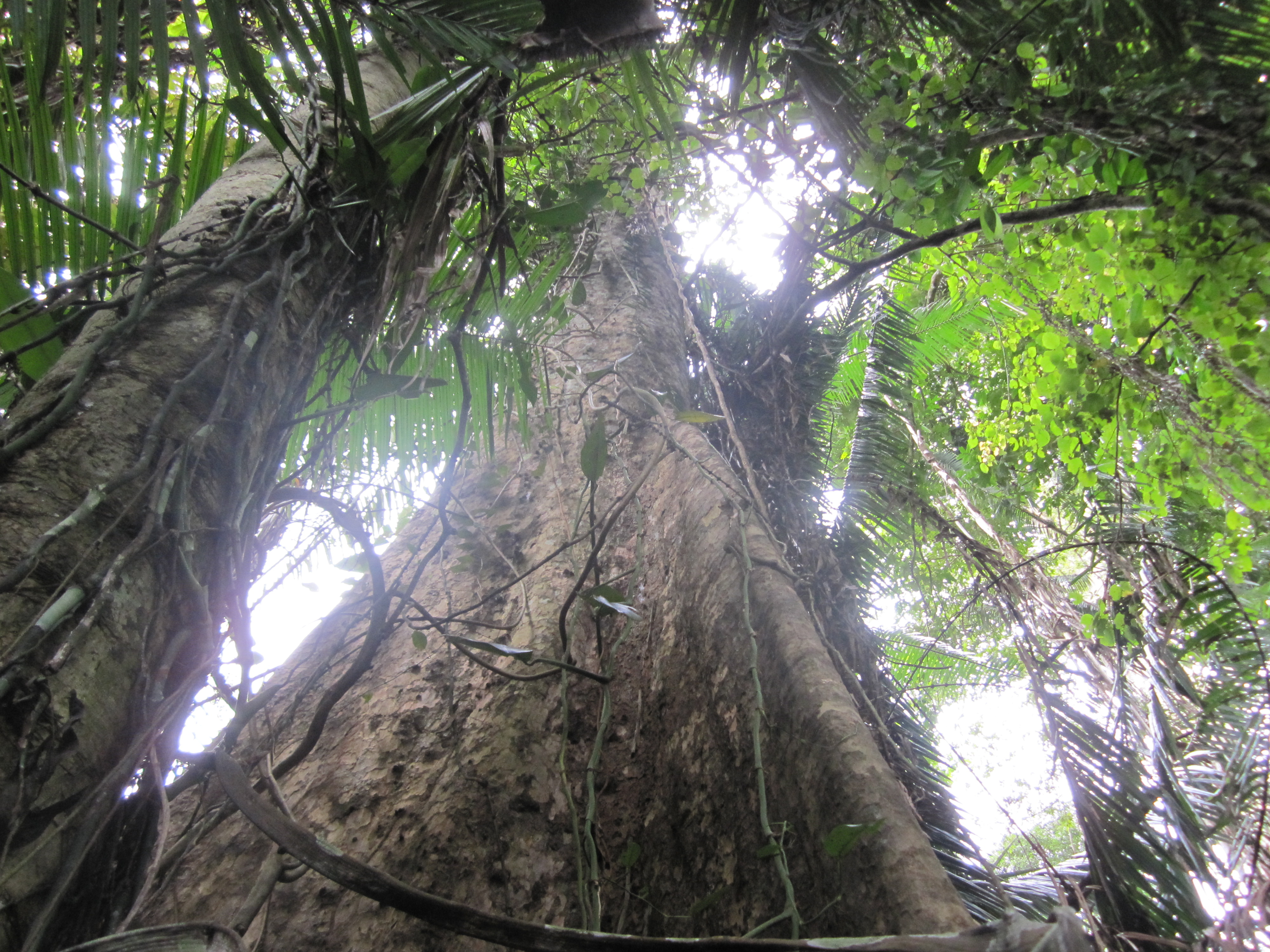
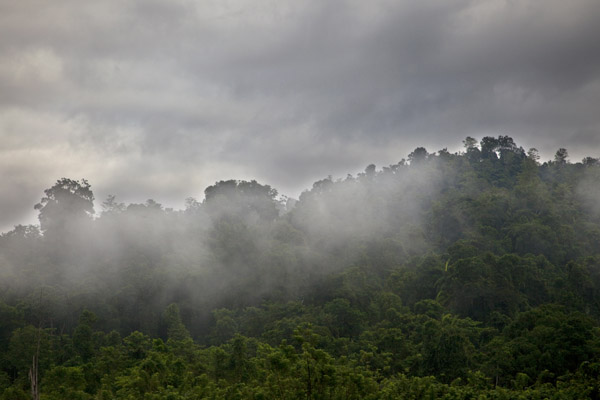
We recently spent time in Northern Sulawesi with Dr. Lynn Clayton at Nantu, which is the 62,000 hectare forest conservation area that the Oxford-edcuated biologist has worked effectively to protect from loggers and poachers over the past 20 years.

I was struck by the incredible size of the trees, the quantity of unusual birds, the general force of nature and indeed the privilege of spending time in such an untouched environment.

Separated from varied threats by a team of rangers who protect trees with trunks the width of houses, the endemic species, the babirusa and anoa among others, Nantu truly is like another world, a parallel and agreeable universe that is largely free of any human footprint.

Immediately evident is the interconnectedness of the forest – the trees, the plant life, the soil, the wildlife, the rain that cascades in waterfalls, that each facet of life adapts to meet its own needs, adjusting for self-preservation.

Also noticeably absent in this harmonious environment: evidence of humans. The footpaths along the perimeter and to a blind for watching babirusa at a  salt lick, the ranger stations, a community of gold miners deep within the forest, are the only apparent  confirmation that humans are part of this forested world.

The opposite side of the Nantu river is where the local  communities have established themselves – many of them brought in as a result of the government’s transmigration program, designed to move landless people from densely populated areas to less populous parts of the country. This tells another  different story: Kilometers of denuded land, the occasional lone tree, fields of wheat and a few other crops.

Still, when crops fail in these areas, inhabitants are forced to look for alternative income and that, most recently, has involved illegal gold mining inside Nantu or rattan collecting for local officials interested in seizing control of the protected area and its precious assets for their own benefit.

Clearly we need to preserve natural environments, which exist as lungs for the world, as repositories of biodiversity and as guardians of the watershed for local communities. But we also need to consider the need of communities to generate income to feed their families, to live decent, rural lives.

Although carbon REDD (reduced emissions from degradation and deforestation) in the future may become part of the puzzle, paying communities to help protect forests and the cost of conservation, that is not the only answer.

Generating livelihoods for communities  and building businesses that help pay for conservation must also be part of the solution. Dr. Clayton has been working with local families to plant cocoa and build livelihoods. So far about 100 families have received saplings over the years and many are now deriving income from their crops.

But even that is a balance. How to satisfy the local community and not attract others looking for similar rewards?

Are you building an interesting forestry conservation model that involves communities?


We recently hosted a forum with the Asia Foundation on Philanthropy and Climate change.  We hoped to encourage Asian funders to draw the lines between climate change (something that seems often hard for the individual to grasp) and the more tangible and immediate air pollution, forestry degradation, water scarcity etc.

We also hoped to then get them to think beyond the environment to a wider philanthropic portfolio and to consider the impact of climate change on livelihoods, health, education – even how funders in the arts might get involved to build awareness around the need to act.

Why? We feel that given the enormity of the problem, it’s often hard for the individual funder, the family office foundation, to see how they might act in any way that is impactful.

But what we found was remarkable energy in the room. Rather than despair, we felt that participants left informed and energized by our panelists and keynote speaker, Stephen Heintz of Rockefeller Brothers Fund, which has an excellent environment and health, southern China program, managed by Shenyu Belsky.

Dr. James Hansen, one of the world’s leading climate scientists and head of the New York’s NASA Goddard Institute for Space Studies, provided an overview of climate science – setting the scene for discussion. Dr. Hansen, an advocate for a carbon tax, spoke of our inertia in the face of an emergency, the possible extermination of species, receding glaciers, bleaching of coral reefs, acidification of the ocean, basically that we are a planet out of balance.

Heintz also spoke about urgency, describing climate change as a “planetary threat that knows no bounds.” He emphasized the particular threat in Asia – that of 16 countries facing extreme risk, five are in in this region and they are among the most impacted, low-lying Bangladesh for example.

In all, he said, global warming could cost southeast Asia 6-7 percent of GDP. Clearly, Asia is squarely at the intersection of climate and development and he emphasized the need for new ideas and new ways of thinking, something that accurately reflects current realities and anticipates new needs.

It is easy, Heintz pointed out, to be discouraged by the science, yet philanthropy, government, civil society and the private sector all have roles to play. In reality , it is imperative that we act because, inevitably, climate change will impact every other issue that we are working on.

Global grant-making, Heintz said, has increased dramatically over the past decade yet environmental issues are way behind, receiving only 5 percent of funding. Resources targeting climate change specifically, of course, are far less.

The philanthropy sector, Heintz said, can play a crucial catalytic role, take risk, experiment, support advocacy to change public policy and trigger larger systemic change. Important will be innovative public-private partnerships, helping to develop emerging models of low-carbon prosperity. His was an excellent speech.

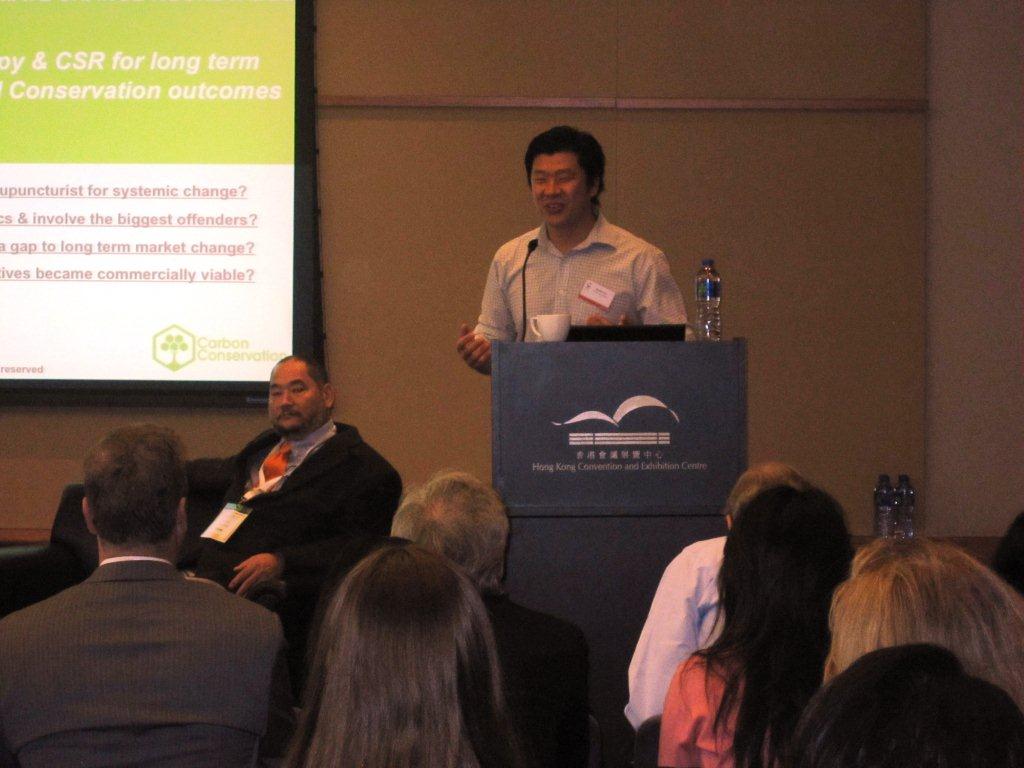
Our three panelists, Runa Kahn of Bangladesh’s Friendship, Dorjee Sun of Carbon Conservation and John Liu, an environmental filmmaker and journalist based in Beijing, spoke of the practicalities of working effectively within this context – and they also were inspiring.

Runa spoke about making life possible for the 4 million people living  in impossible circumstances in Bangladesh’s northern chars, John Liu on a massive ecological restoration project in China and showed the results, Dorjee on carbon, community and market solutions for saving forests.

The entire session was expertly moderated by the Asia Business Council’s Mark Clifford who managed to draw together the discussion, keeping an often amorphous and difficult topic moving toward practical solutions and away from fear.

The forum was a private side event to the C40 Climate change conference early this month organized by the Civic Exchange and supported by the Hong Kong government and Jockey Club Charities Trust.

It would be great to hear about other experiences linking climate change with a wider philanthropic portfolio, about nudging funders into action in this arena.

Global environmental damage from human activity cost the world US$6.6 trillion last year, according to a new UN study.

That amounts to 11 percent of global GDP and amounts to 20 percent more than the US$5.4 trillion decline in the value of pension funds in developed countries caused by the global financial crisis in 2007/8.

The study, by UN-backed Principles for Responsible Investment (PRI) and UNEP Finance Initiative, estimates that the world’s top 3,000 public companies were responsible for one-third of the damage, or US$2.15 trillion.

Other takeaways from the study:

  • Environmental harm could affect significantly the value of capital markets and global economic growth
  • Global environmental damage is estimated to cost $28 trillion by 2050

Why should investors care? The study warns that as environmental damage and resource depletion increases, governments will start applying a more vigorous“polluter pays” principle.

That means the value of large portfolios will be affected through higher insurance premiums on companies, taxes, inflated input prices and the price tags for clean-ups.

As a result, workers and retirees could see lower  pension payments from funds invested in companies exposed to environmental costs, says the study, conducted by Trucost, the global environmental research company.

Sectors most responsible for the damage, including air and water pollution, general waste, resource depletion and greenhouse emissions, included: Utilities; oil and gas producers; and industrial metals and mining. Those three accounted for almost a trillion dollars’ worth of environmental harm in 2008.

Why are investors still not providing leadership on this? Clearly, environmental externalities generated by one company have the potential to affect their portfolio. There is every incentive.

Already in China, low estimates are that Water scarcity and pollution alone represent 2.3 percent of that country’s GDP, according to the Asia Water Project. And China has said that, overall, environmental pollution costs the country 10 percent of GDP annually.

A sustainable global economy means we MUST stop drawing down our natural capital.


With air pollution at critical levels, the Hong Kong government fails to act to protect public health. After years of study, public consultation and dithering over what to do, there still is no action to revise air quality objectives, last rewritten in 1987.

Continue Reading...
Mountains of garbage in Mumbai

Mountains of waste


We hear about climate change all the time now, we know it’s bad, we understand much of the science behind the phenomenon. But what can we do? No really, what CAN we do? How does this broad concept connect with our daily lives? 

We turn off and unplug appliances, we try to take public transport where possible, we use fewer resources, turn down the air conditioning in summer and heat in winter, we buy less bottled water. 

But often we don’t stop to think about the rest of our lives. We still want to eat strawberries in winter, meat flown in from the U.S. We (or our children) still buy clothes where often quantity and price reigns over quality. 

We look for lower prices (because we’re hooked on cheaper is better) and then don’t have to think so hard about whether or not that particular cheap item that clearly is not taking into account the environmental or social cost of  production is actually needed.  

We change our cars regularly, buy the latest Apple gadget (must have the ipad, the latest computer to stay in touch) and think nothing of chucking an iphone, ipod that has lasted only a year. 

What happened to the time in the not so distant past when we romanced a dress for a long time and just one purchase was ok, when we could buy fresh local produce and meat in season, when one car lasted a decade or more, when we didn’t need gadget upon gadget to be happy?    

So back to climate change: All of that consumption, flying goods around, needs energy. Production and energy (produced largely by coal in China) at least at the moment lead to air pollution and climate change. Sometimes we forget the connections. 

 In Hong Kong this week Clean Air Network has been good to remind us  with its tongue-in-cheek Fresh Air video what we face if we don’t change our bad habits:  http://www.youtube.com/watch?v=lmH3xCpOSW8

In Hong Kong we rightly complain about the state of the air we are forced to breathe and the government’s apparent lack of interest in addressing the pollution challenges – despite  HK$ half-trillion in fiscal reserves this year.

The moribund HK government seems incapable of taking action to protect its citizen’s health despite having the financial resources to do so. Clean Air Network is working hard and successfully to educate the public and stir the government to act, providing the tools and support to do so – hand-holding of sorts.

But perhaps part of the challenge is that in Beijing, from where I am working for three weeks, Hong Kong’s pollution pales by comparison – not that this city should set any standard!

Here, my eyes are a constant rimmed-red, a smog headache challenges concentration and my sinuses are in revolt. Here, the clouds are but a memory and weather is either cold or hot but never sunny, it seems, but there is only a steady grey. The near distance fades into a smog that anywhere else would be unbelievable.

This is the price of China’s progress, and, to be fair, of pulling an estimated 600 million people out of poverty over the past two decades by fulfilling our Western need to consume ever-more products. According to the ADB, over the past 20 years, China’s poverty rate fell from 85% to 15.9% – a huge challenge for any government and unmatched anywhere, anytime.

Still, what we hear more about in the West is the fantastic progress machine that is China, the well-oiled production centre for the world’s consumers.

The flip side of that for China’s citizens is the polluted rivers, the smog-filled air, the cancer villages in evidence countrywide, the drained aquifers, the contaminated land. All of these will be the Beijing government’s newest challenges if it is to keep its population healthy and maintain social stability, which is the utmost goal.

Highly polluted areas near factories have shown increasing cases of cancer.  Southern China is replete with communities that recycle electronic waste and here people are exposed to toxic heavy metals such as cadmium and mercury.  The country’s myriad chemical factories produce carcinogens that enter the water and soil, also contaminating food grown on the land.

According to a recent Guardian article, in 2007, cancer was responsible for one in five deaths, and Chinese farmers are more likely to die of liver and stomach cancer than the world average.

Water supplies are polluted and aquifers significantly drained, something leading environmental activist Ma Jun warned about ten year’s ago in his book, China’s Water Crisis, which considered the local equivalent of Rachel Carson’s Silent Spring.

The Qinghai-Tibet plateau area suffers from environmental degradation that is threatening three major rivers: the Yangtze, Yellow and Mekong. Melting permafrost and glaciers in the surrounding mountains are also eroding the grasslands and wetlands, causing the ground to lose its capacity to absorb water, according to AFP.

Xin Yuanhong, a government scientist quoted by the news agency says that at the current rate, 30 percent of the region’s glaciers could disappear within 10 years.

Climate change is also affecting the 580 million people living in these river basins.  This crisis also affects food security; drought and drying up water sources are severely lowering crop yields in the area.

By all accounts, the government increasingly understands the severity of the challenge. Careful Chinese environmentalists are being allowed to speak out. Indeed, many seem to be encouraged by the government to highlight bad practice by companies breaking local laws by emitting pollutants into the water, air and ground. Information disclosure has taken leaps forward in recent months.

Ma Jun and his Institute of Public and Environmental Affairs over the past several years have divulged information in online databases of air and water violations by factories throughout China. He has created a groundbreaking “blacklist” of polluters. At last count, IPE databases listed more than 60,000 air and water violations.

To be removed from the list, companies must take corrective action and accept IPE-supervised environmental audits of their Chinese factories. Ma is also a champion of increasing access to environmental information, which he believes will bring public pressure on companies to operate more responsibly.

In Yunan Province, Yu Xiaogang, another courageous environmentalist I met with recently, is also using information disclosure, to gain bank data. He and his group, Green Watershed, along with a network of nine other NGOs, are compiling information on loans granted to development projects that are damaging to local populations.

The group recently published the environmental record of 14 Chinese banks, looking at their policies, regulations, investments and loan portfolios, noting which were connected with environmentally damaging projects.

Yu is also working with communities to help them open channels with local financial institutions to discuss social and environmental impact ahead of any loan being granted to a large development initiative.

That Beijing seems to be backing the sort of discussion underway in China is certainly encouraging. It seems Hong Kong should be setting standards in the environmental arena not lagging behind its severely challenged neighbour.

Babirusa

If I were a pessimist, this might be a moment of total despair over the future of high conservation value tropical forests in Indonesia.

The question we and others have struggled with has been: how to make the economics work for conservation? Logging is profitable business for large landowners; for communities, cutting trees can often represent the only source of income.

Most recently, hopes have rested on the carbon markets and REDD as a source of funding for both communities and landholders, paid for by companies wanting to offset their carbon emissions.

But Copenhagen was a disaster, leaving little hope for any global carbon framework anytime soon, while the weak U.S. Climate Change bill looks like it won’t be up for debate this year.  The carbon markets are in disarray.

Meanwhile, climate science itself is embroiled in controversy over seemingly not very much and last year’s financial markets meltdown has made investors innovation adverse.

When one of our carbon champions returned last week from a tour of the U.S. seemingly distraught over the state of the markets, we knew that was at least not an immediate answer to funding conservation, despite the abundance of REDD carbon projects dotting Southeast Asia!

But what are the solutions? What can possibly compete with the huge profits from logging virgin forests?

For two years, we have been working with Oxford-educated biologist, Dr. Lynn Clayton, who for the past two decades has courageously worked to protect the 62,000-hectares Nantu forest in Sulawesi, Indonesia.

Working with a small team, Dr. Clayton has done an excellent and recognized job keeping hunters from the region’s many endemic species such as the babirusa and anoa, which are described  in Alfred Russell Wallace’s 19th century tome, the Malay Archipelago, which chronicles the naturalist’s journeys in the unique region.

Under consideration has been an off-shore trust fund that would generate resources to support the conservation effort at Nantu and at the same time help promote alternative livelihoods for local communities, which are vital to any such effort.

But trust funds, which involve sizable up front chunks of cash, have fallen out of favour in the rush to carbon thus raising those sorts of resources (we estimate that US$5 million in a loan or donations would help secure Nantu) has proven difficult.

With carbon less certain than ever, the other alternative has been to generate business models around Nantu that potentially could generate funding for conservation as well as support local livelihoods.

Once again, however, the sticking point seems to be the feasibility studies and business planning that involve significant upfront costs with uncertain returns. What are interesting conservation finance models, perhaps from other regions, that are working?

We’ve been thinking a lot recently about how most people view philanthropy. We’ve been thinking that they view charitable giving  as something intensely private, something that comes from goodwill, from the heart, something that ought not to be confused with the rest of life, with numbers, with market norms.

We’ve been thinking that many people don’t really want to focus on the tough issues, on the “why?” for philanthropy: That 3 billion people, almost half of our world’s population, lives in poverty on less than US$2.50 a day, that 1 billion people don’t have access to clean drinking water, that 24,000 children die daily from poverty.

And then beyond poverty, the environmental challenges we face from increasing temperatures and rising sea levels to disappearing forests, from dramatic declines in fish populations to loss of terrestrial biodiversity.

We’ve been thinking that maybe we genuinely don’t have time in our busy lives to focus on what’s happening in the developing world or even the next neighborhood over, or maybe we just don’t want to see for lack of solution. What can we do, after all but write that check and feel that we have done our part?

It is true, that poverty, water shortages and the myriad environmental challenges don’t yet directly impact most of our own lives, which are full enough of each day’s stress.  So when it comes to philanthropy, to volunteering, we want to just enjoy the giving.

We prefer to contribute with emotion, with friends, regardless of the cause, without looking at numbers, statistics, without necessarily thinking about the end result. We want to give to what we know, what we assume will work, what we believe has always worked. We want the safe option, to be part of a community of people doing the right thing in the comfort of friends.

Understandable when we consider that the word philanthropy, loosely translates from its Greek roots as “love for humanity.”

But the reality is there is much more good work that could be done with the US$300 billion Americans give each year – an estimated 45 percent of world philanthropy. And the reality also is that to fix the damaged world our children will inherit, the poverty of our burgeoning world population, we must offer more than just “doing good” as an answer.

We must work against the sense of cross-purposes involved in thinking about the application of market norms to things social if we are to make the real and urgently needed change.  We must pay attention to the issues to which we are giving and use our philanthropy wisely to ensure we are indeed part of the solution.

There is precedent for doing more. We can look into philanthropy’s not so distant past to see that the Rockefellers and Vanderbilts were as innovative as it came in their charitable works. And of course it was Andrew Carnegie who so famously recognized the need for smart philanthropy, warning that most charitable acts go awry.

At essence, the philanthropy sector must draw on all resources at its disposal to build codes and gather information on and publicize successful or failed practices, we must learn to harness markets more effectively, to innovate around business models that can bring the sweeping changes we so badly need. There needs to be more tolerance of risk with charitable dollars.

Of course some of this is already happening with the growth of venture philanthropy, micro-credit and social entrepreneurship, with new models of investing for social impact, but there needs to be more and faster.

How can we promote transformation, not just in the professional philanthropic sector, but also among donors, which in turn will fuel change among implementing non-profits? How can we transform the attention paid to short-term results into a more patient investing in our future?

I recently spent some days in Bangladesh with Friendship and the excellent social enterprise’s executive director, Runa Khan. Friendship works with tens of thousands of the world’s most-vulnerable people who live in the northern Chars, remote and shifting sandbar islands that flood in winter and suffer drought in the summer.

Located about seven hours from Dhaka, these must be some of the most inhospitable habitats anywhere and consequently life expectancy for the forgotten people is only late 40s. In the rains, the islands shrink to slips of land with a few banana trees, with inhabitants and their livestock often forced to rooftops to survive the floods. In the heat of summer, the walks to the villages are often as long as three kilometers from the river through unforgiving sand.

An estimated 4 million nomadic people inhabit the 200 islands woven through the Brahmaputra river where land flattens toward the Bay of Bengal. The sand dwellers migrate from one island to another as much as 50 times in a lifetime, carrying with them their tin houses in the floods.

Climate change is clearly felt in Bangladesh’s distant northern and equally distant southern regions, where Friendship is almost alone among NGOs in working. Government reach here is also limited, Khan says. The people used to at least have certainty about the weather patterns but now the rains and droughts are harder to predict and more extreme, she says.

Friendship started its work more than ten years ago providing health care to the communities on a specially outfitted hospital barge, brought from France by Khan’s now husband, French sailor Yves Marre.  Now two hospital ships and an ambulance boat ply the Brahmauptra spending a month or two in each location, offering primary care at about US 10 cents for men, 5-7 cents for women and children as well as affordable basic surgery to the region’s weather-beaten inhabitants.

From medical care, Friendship has extended into education, (both for children and adults), livelihood and vocational support, working closely with communities to help them meet all their needs. With a staff of around 350, a complex schedule of foreign doctors and other medical professionals who fly in for specialized care, Friendship works with an estimated 40-50,000 people previously served mostly by microfinance providers, who often prayed on the extreme poverty.

Khan points out that although microfinance can work for people with at least some education and means of support, it is often not appropriate for the poorest, who will use any available funds simply to buy food for their families.    Many lenders, she says, show up on the islands with offers of cash, promising interest rates of only 10 percent annually. Without knowledge of basic arithmetic, the people take the money, spend it and then must meet the payments that often add up to rates closer to 50 percent, she says. And these are some of the better microcredit institutions. Money lenders charge as much as 120 percent.

“When we first start working with a char one of the first things we must do is unwind the microfinance loans,” Khan says. “People at that level of poverty need grants and other forms of support not loans.”

Khan says that the char people more than anything need, “hope for tomorrow” and Friendship offers education where there were no schools, healthcare where there were no doctors, livelihoods where people had none, community organization where people were disperse and disaster preparedness where there wasn’t any. A focus is on discussion, trading information, and building savings to prepare for years where the floods or droughts are life-threatening or force a relocation.

Friendship is also working to create a harmonious environment in the stark landscapes, building appropriate and local farming techniques for sand, bringing in solar where they can – with an emphasis on keeping people in their places of birth. Without Friendship, many people from these regions have swelled the slums of Dhaka in search of work.

Schools can be disassembled in three hours and moved to higher ground, girls are taught weaving and dying – skills that help them contribute to the family income and avoid an early marriage (12-14 was the norm before Friendship arrived). Community health workers are trained and sent to the villages, where they teach local people about nutrition, sanitation, about warning signs in a pregnancy and basic child health techniques. They also can dispense basic medicines.

“We listen to the communities, hear their needs and respond in ways that are appropriate,” says Khan of Friendship, which is surely one of the more innovative organizations I have seen.

Catch it if You Can

sleclue —  March 25, 2010 — 3 Comments

Our oceans are in deep trouble.  A growing population with an insatiable appetite for seafood has driven exploitation of our seas to such an extent, that some scientists predict a global collapse of fish stocks by 2048, or thereabouts.

Daniel Pauly, a fisheries professor at the University of British Columbia, likens these dire straits to Bernard Madoff’s now infamous ponzi scheme. As our oceans have been plundered and fish stocks declined dramatically we simply moved our efforts to exploit stocks elsewhere.

Pauly’s reasoning is simple:  Madoffs’ scheme required a pool of new investors to generate revenues for past buyers and when these disappeared so did the scheme.  The global fishing industry similarly requires new stocks to continue and when the supply is ultimately exhausted a collapse is inevitable.

The consequences for us all, however, are far beyond the havoc created by Madoff.

Numerous factors contribute to the crisis. Perhaps foremost among these is the combination of increasingly sophisticated technology that can locate all manner of fish and the phenomenal industrialisation of a once relatively benign practice.

As with now intensive land-based food production, the technology and the scale of fishing is almost beyond comprehension. The techniques that now imperil our ocean life range from bottom trawling, which rapes vast planes of the ocean floor, to deployment of Fish Aggregating Devices (FADs) and its consequent bycatch.

In Charles Clover’s relatively recent documentary ‘the end of the line’, bottom trawling is likened to ploughing a field seven times in one year. Fish, indeed the entire marine environment, simply don‘t stand a chance if we continue as we are.

Is talk of a potential collapse scaremongering? A look at statistics indicates otherwise. In a 2003 paper, Ransom A. Myers & Boris Worm wrote that declines of large predators in coastal regions have extended throughout the global ocean, with potentially serious consequences for ecosystems.

Part of the problem remains that fishing is heavily subsidised and global regulation is for the moment at least, not a force to be reckoned with. The dramatic decline of the majestic blue fin tuna and many shark species serve as cases in point.

The fate of the Blue Fin was sealed just a few days ago when the UN Convention on International Trade in Endangered Species of Wild Fauna and Flora (CITES) failed to ban international trade. This unfortunate species now faces extinction in the not-distant future.

Sadly, the short-term gain of a few has once again triumphed at the expense of the environment.  In the meantime, things are as bad if not worse for sharks.

Despite evidence to suggest that many shark species are critically endangered, only five species are protected under CITES. Of those, it is perhaps encouraging that two are banned from international trade, however on the down side it would seem that these are virtually extinct already.  In Hong Kong, which accounts for 52% of global shark fin imports, there is no regulation beyond CITES.

As fish stocks decline we become ever more cunning in hiding the truth as we turn to less attractive species for food.  Rock salmon served in many fish and chip shops in the UK for example is actually dog fish, a species of shark.

As Clover points out in his book, other unappealing species that are ending up on our plates are being creatively recast – black scabbard has become sabre and the increasingly endangered Orange Roughy is now known as empereur.

The problem is deeply worrying – and not just because hundreds of millions of people depend on fish for animal protein, or that fishermen the world over rely on healthy catches for their livelihoods.  Havoc is quite literally being wreaked on an essential resource on which depend for survival.

We are causing significant changes that we don’t yet fully understand to a vast ecosystem that requires balance to provide the benefits we take for granted.

As an example, there have been increasing reports of mass jellyfish swarms. One of the causes commonly cited is industrial-scale fishing.  Since fish prey on jellyfish, it shouldn’t be surprising that a consequence of overfishing is an explosion of these creatures in our seas.

What then is the answer? Aquaculture has increased dramatically in recent years but unfortunately, this practice is not the panacea we might like it to be and in fact has its own issues.

One concern is the widespread practice of raising predatory fish such as salmon as opposed to herbivorous fish such as carp.  A Worldwatch Institute report produced two years ago offers the following startling facts:

  • Farmed seafood, or aquaculture now provides 42% of the world’s seafood supply and is on target to exceed half in the next decade
  • The average per capita consumption of farmed seafood has increased nearly ten fold since 1970
  • Early fish farming raising herbivorous species on vegetable scraps and increased the overall supply of seafood
  • The growth in modern fish farms focused on large-value predatory fish fed on smaller fish is now contributing to a net drain on seafood supply
  • There is a growing scarcity of fish feed.   Today, about  37% of marine fish landings are reduced to fishmeal and fish oil
  • Four fish groups – marine shrimp, marine fish, trout and salmon consume more than half of the world’s fishmeal even though they represent just seven percent of global aquaculture and less than three percent of total seafood production
  • Twenty kgs of feed is required to produce just 1 kg of tuna (it is worthy of note that tuna farming or ranching as it appears to be known, for the most part involves catching juvenile wild tuna which are then caged and fattened with fish protein )

In summary, the Report indicates that despite ongoing improvements in feed ingredients and technologies, the rapid growth of fish farming in recent decades has effectively outweighed any gains in feeding efficiency. Modern fish farming is a net drain on the world’s seafood.

As a fish eater, it’s difficult to find sources of sustainable seafood such as Marine Stewardship Council (MSC) certified varieties and blatant mislabelling or creative naming of fish don’t help.

While there are many fish guides around, I for one find them hard to use, given the lack of knowledge of staff in restaurants and supermarkets and the need to identify for example the location of the catch.  Still I use these where I can (iphone apps have been helpful) and am increasing my awareness of locally caught ‘non-endangered‘ seafood.

In this instance, the low-hanging fruit perhaps are species such as blue fin and to a lesser extent yellow fin tuna and farmed salmon, amongst others, that are easier to recognise and so avoid.

Another approach is simply to reduce consumption of the larger long-lived fish with lower fecundity and go for the smaller short-lived species that reproduce rapidly – sardines and anchovies for example.

If chefs can be creative with these smaller species, maybe eating anchovies can become as trendy as blue fin sushi.  The UN FAO points out that consuming longer-lived species such as Orange Roughy, which can reach 200 years in age, means that fish on your dinner plate could have hatched at the time of Napoleon Bonaparte!

But on the bright side, with the Oscar for best documentary going to “the Cove”, perhaps even Hollywood finally has taken note of the plight of marine species.

Films such as “The End of the Line”, “Sharkwater” and “Food Inc.” make it easier for all of us to understand enough to consume more sustainably, ask more questions of those supplying our food and lobby our governments to act.

In the meantime, I look forward to the release of “Oceans “ on Earth day next month – a film that by all accounts promises a breathtaking view of the beauty and power of a valuable resource for which we sadly seem to have little regard.

Choosing how to give philanthropic dollars is usually a personal, often private, and hopefully rewarding enterprise many people like to keep close to home.

Those who spend much of their lives juggling returns on their financial investments and building wealth, often prefer to let other factors determine how to give to charity; emotion, for example, and perhaps friendship since frequently giving is something done in the comfort of circles or with friends.

The ever-bigger M'Lop Tapang centre for street children in Sihanoukville, Cambodia

But what is the significance of the donor community? Giving USA reports that every year, 40 million individual donors in the U.S. contribute $250 billion which represents more than 75% of total giving. That is a significant wad of cash that could be put to good use cleaning our environment and making our world a better place for marginalized communities. And that’s just in the U.S.

Obviously, there is no right approach to philanthropy and no absolute way to judge how effective a donation has been, despite that over the past two decades a whole industry has grown up around measuring social impact. But I think that once again we know more about what we don’t know rather than what we do.

Why do we need to think about how we give anyway? Isn’t that the point of giving – not to expect any return? I would say yes, true on one level, but not really. Why? Much has been written recently about the pitfalls of aid more generally. Two of the more vocal critics are New York University’s Bill Easterly and Dambisa Moyo whose book Dead Aid caused wide controversy.

The trouble is, without a concerted strategy or effective tools to guide us, many individual donors, grant-making bodies and foundations alike fall into the trap of providing aid that in the longer-term CAN be more damaging than helpful, despite our best intentions.

Because of issues around governance, particularly in a region like Asia where corruption is rampant, donors bypass governments, choosing instead to invest in a network of NGOs, which keeps these same NGOs flush with cash and lots of people employed.

If the NGO isn’t particularly thoughtful and doesn’t engage local government, this giving strategy also deprives the state of any stake in change and almost relieves them from the responsibility of improving the lives of marginalized citizens without a voice.

Another issue is that donors frequently prefer to contribute to contained NGO projects rather than to strengthening the organization simply because programmatic support fits with a particular donor funding agenda.

Although building new programs or expanding existing ones is important in terms of an NGO widening its impact, these often come at the expense of organizational support. It’s hard to see how an NGO can create a program, monitor it and measure its impact without sufficient organizational resources to do so.

Occasionally, or more than occasionally, an NGO has bent its needs to receive the targeted funding so there is little incentive or lack of adequate skills to really build.

And often that programmatic support is short term, given in periods of two to three years, after which the project is expected to be magically self-sustaining. Usually that is unrealistic and once funds are gone so is the program, leading to a real waste of resources.

So how do we make sure, as donors, that we are working as effectively as we can be with our own resources and not operating counterproductively, particularly in the developing world where issues are deep and broad?

This brings us right back to much talked about measuring impact. An excellent Wall Street Journal Article on Friday, Measuring the Bang of Every Donated Buck by Alice Hohler is a good discussion of the issues around this topic. http://bit.ly/d3Afil.

She points out that while many companies and NGOs have developed formulas for measuring the effectiveness of a donation, there still is no real magic box. She points to the tricky question of the unique qualities of nonprofits that are each fulfilling a social need in their own way.

There is little standardization in this field and little reason why one set of measures would fit all. Naturally, each organization then requires its own evaluation to assess its effectiveness and that is prohibitively expensive. It certainly isn’t scalable, which is another obsession among the donor community.

At the same time, any analysis of impact on the part of an NGO is only as good as the information gathered and few organizations have the resources, skill set or manpower to gather relevant data and then assess the real benefit.

An organization that  works to get children back into school will have a much easier time determining impact than for example a conservation group that works with communities to educate them about biodiversity and the value of preserving their forests.

But even in the first instance, we see there are many, many ways to count!

And then, how to compare organizations working in different spaces to determine which would use additional resources more effectively, providing the greatest benefit to a particular community?

We find that the best way around this question is to work in a holistic way with organizations, to help them set their own measurements with their particular children, to constantly work with them on developing initiatives and monitoring their effectiveness.

In that way, we can help them refine impact, reach more children or work more effectively in a particular conservation space. We shy away from the obvious numbers that are so often meaningless, preferring instead to let the work tell the story.

Any thoughts on interesting innovation in impact measurement seen working well?

Asia Water Project: China

Lisa Genasci —  February 25, 2010 — 1 Comment

The ADM Capital Foundation and Civic Exchange today launched in beta the Asia Water Project: China and AWP’s first piece of commissioned research, Water in China: Issues for Responsible Investors, authored by the independent research company Responsible Research, which is Singapore based.

Feels great to get the water portal birthed and visible, even if it’s only in testing phase ahead of the official launch on March 18 in Hong Kong. That will happen with IPE’s Ma Jun, who was the inspiration behind the water portal. It was a desire to translate Ma Jun’s data from the IPE website that names and shames water and air polluters in China, (see Jan. blog) that first inspired ADMCF to create AWP. Ma Jun, who wrote the first major book on China’s water crisis in 2000, uses only government emissions and penalties data on his site and in that way has been allowed to work relatively unimpeded in China.

ADMCF saw there was space to fill a lacuna in information relating to China’s water supply, management and pollution and at the same time better inform investors. We see there are both risks and opportunities in China’s growing crisis. Informed investors can help shape how companies respond to water challenges. Ina Pozon, who has built and manages AWP and ADMCF environment director, Sophie Le Clue,  have worked tirelessly in recent weeks with freelance writer, Pua Mench, to get the site in shape. Still work to do but today we are a big step closer!

Bloomberg sponsored today’s event, which featured Christine Loh of the CE, Lucy Carmody of RR and Guo Peiyuan of Beijing’s SynTao, an AWP partner and participant in the RR water research.

The research, found here: http://www.asiawaterproject.org, showed that China may be looking at trade-offs between access to clean water and economic growth. At the national level, China’s water shortages are thought responsible for direct economic losses of US$35 billion every year.  This is 2.5 times the average annual losses due to floods.

The report points out that sectors where China dominates globally, such as in steel, textile, paper and forest products, are heavily water intensive. Fluctuations in quantity and quality of water supply in these industries carry significant potential risks to earnings.

The new report draws on case studies from ten industries that have the most impact on water in China including agriculture, forest products, textiles and beverages. As water becomes increasingly material to investors in China, they will need to be more pro-active in looking at how listed companies are addressing supply issues.

While there is some understanding of water-related risks to companies and investors, “a key barrier is the lack of reliable, comprehensive information on water issues in China,” according to Ina. “The Asia Water Project has a unique role to play in fast-tracking this trend, through its commissioned research and its new web-based information portal.”

Earlier this month, the Chinese government released the findings of a pollution survey that show water pollution levels in 2007 were more than twice the official estimate, in part because previous reporting had failed to take agricultural contamination of water supplies into account.

Christine Loh reads this as good news that the Chinese government has done its homework and now understands that “the problem is as big as it is urgent.” She anticipates that “there will be more dialogue and debate in China this year” as government plans require reductions in wastewater pollution that are not easy.

The new investor report  also highlights some shocking statistics: 70 percent of China’s rivers and lakes are “significantly” contaminated, 50 percent of the country’s cities have polluted groundwater and over 30 percent of China is affected by acid rain.

Most of us agree that deforestation on the scale we have seen in recent decades is undesirable and unsustainable.

Our tropical forests are in dramatic decline, pumping tons of carbon into our atmosphere and causing changes in temperature and rainfall worldwide with potentially devastating consequences for our planet.

The problem remains, how to tackle this critical problem in developing regions, where corruption is endemic, how to pay the enormous costs of protecting forests and engaging the local communities that depend on them for their livelihoods.

Reversing global deforestation will require industrialized countries to invest billions annually in forest protection. It is worth remembering, however, that last year U.S. government put aside $700 billion for banks, insurers and automakers during the financial crisis as part of the Troubled Asset Relief Program.

By now, we know the story: Rainforests soak up huge amounts of planet-warming carbon dioxide. Deforestation releases retained CO2 released into the atmosphere.  Forest destruction contributes about 20 percent of mankind’s greenhouse gas emissions annually, according to the U.N. climate panel. Indeed, tropical deforestation is more damaging to our planet than the transport sector or factories, with one day of logging equivalent to the carbon footprint of eight million people flying to New York.

And why do we care? Our rainforests form a vital cooling band around the earth’s equator, generating a large part of our rainfall and acting as a thermostat.  We perhaps also aren’t aware that 50 per cent of life on earth exists in these humid forests, which cover less than 7 per cent of the planet’s surface. We are far from understanding the real consequences of losing the biodiversity we seem to take for granted.

Yet our governments, and indeed most of us, continue to act as though our tropical forests are expendable, that there is no impending climate crisis, biodiversity is a given, perhaps unimportant, and anticipate little, if any alteration in our lives of consumption and energy use.

Clearly, December’s global climate powwow in Copenhagen was the best reflection of this, with no real sense of urgency conveyed by governments gathered there.  Country delegations arrived by private jet, were ferried around town in gas-guzzling limos – not exactly the right tone for a crisis meeting on climate.

There had been hope to gain a legally binding international treaty committing nations to mandatory cuts in greenhouse gases but none was forthcoming, lost once more in the all too familiar regional bickering. And chances are slim of any agreement from the next round of U.N. climate talks in Cancun, Mexico, particularly following the resignation last week of Yvo de Boer, who has led the process for four years.

The pledges that de Boer did manage to eke out of Copenhagen will merely stabilize emissions by 2020. By most accounts, we need to achieve reductions  of at least 50 percent by midcentury – something that can’t be achieved without big cuts from the major emitters, which are the U.S., China, India and Brazil.

Part of the problem lies in ascertaining, at the international level, who should pay to conserve our forests. Developing nations want the right to develop unimpeded, while the United States wants to see significant emissions cuts from China and India that would be on par with its own and doesn’t want to be held accountable for cost.   Fundamentally, the U.S. has no effective national strategy of its own and thus is really not in a position to take the lead.

The assumption is that at some point, nations will get it together to achieve meaningful emissions reduction and carbon will become a real part of the solution. In the meantime, regional initiatives such as the U.S. Climate Change legislation currently stalled in the U.S. senate are evolving and could bring some movement in the carbon picture, generating resources for forestry conservation.

But will this be too little too late for our forests and what is the solution for them while we wait?

The bottom line is that in an attempt to protect what is left of our precious stores of tropical timber and the estimated 1.6 billion people who live amongst them, environmental groups have poured tens of millions of dollars into conservation over the last two decades without any real gains.

Global Witness co-founder Patrick Alley, said in a worth-quoting speech last year :

Virtually every intervention by the international donor community into the forests sector over the past few decades costing hundreds of millions of dollars has essentially been to patch up the holes in enforcement to stop the haemorrhaging of illegal timber and corruptly looted revenues. And these interventions have ranged from certification, chain of custody systems, governance, capacity building, law enforcement and there has been precious little success in that litany. And on top of this, we have the increasing threats of conversion to plantations and agricultural encroachment http://bit.ly/fiCvz

The U.N.’s Food and Agricultural Organization says about 13 million hectares, or an area the size of England, are still destroyed annually. In all, half the world’s tropical and temperate forests are now gone.

Author and environmental advocate, Gus Speth, ( http://bit.ly/bSBjOR) pointed out in a recent speech that species are disappearing at rates about 1,000 times faster than normal in a spasm of extinction not seen in 65 million years, since the dinosaurs disappeared.

Changes in our rainfall patterns have meant that over half the agricultural land in drier regions suffers from some degree of deterioration and desertification.

A key concern, if we are to reverse this trend, is either how to pay for conservation or, alternatively, how to make conservation pay; at a national level, how to justify the loss of revenue for developing countries that need the income.

The sad reality is that logging in the tropics generates enormous profit, but not for local communities and mostly not for governments in the form of taxes. Instead, much of the profit finds its way into corporate coffers and the offshore accounts of connected local individuals through corruption and illegal practices. The profit pressures on forests are huge from these interests. Biodiesel and palm oil have now also entered the equation, adding to the strains.

One initiative that tries to address the question of  how to generate profit for conservation and formalized at the Copenhagen talks was a U.N.-backed forest protection scheme called Reduced Emissions from Deforestation and Degradation or REDD.

This would include forests in the global carbon markets,  allowing polluters to earn tradable carbon credits by paying developing nations billions not to chop down their trees.  Local communities are supposed to earn a share of REDD credit sales to pay for better health, education and alternative livelihoods that persuade them to protect rather than cut down their forests.

But the revenue-sharing arrangements will differ for each country. Some NGOs worry that once again little support will filter down to the communities, with central and provincial governments demanding control of the money.

Another problem is that carbon measurement and accounting as part of any REDD design is complex and time-consuming, requiring laws to be enacted, officials to be trained and investors to be assured that the scheme won’t be undermined by corruption.

And finally, ensuring the forests aren’t simply cut down later, or that deforestation is displaced to another region or country, is another concern. REDD’s final technical design will have to address these issues.

Still, the well-regarded Eliasch Review (http://bit.ly/d99kM3) suggests that including REDD in a well-designed carbon trading system could provide the finance and incentives to reduce deforestation rates by up to 75 per cent in 2030

Still, in Indonesia, where the REDD discussion is quite advanced, there have been warnings that billions of dollars clearly are at risk from graft unless the country puts strong oversight mechanisms in place, according to a recent report released by CIFOR. (http://bit.ly/cfld28)

“Investors should be looking very carefully at the financial governance conditions in the countries where they will be investing their funds. Like Indonesia, many tropical forest countries have long track records of mismanaging public financial resources, particularly in the forestry sector,” said the report’s co-author, Christopher Barr.

Indonesia, which is one country in which ADMCF works on forestry issues, is the world’s third-largest area of tropical forest and the world’s third-largest emitter of carbon after the United States and China because of the massive destruction there of rainforest and peatlands.

Last year, Indonesia set up a legal framework for REDD. Several pilot projects are under way and the governments of Norway, Australia, Germany and the U.S. have promised millions of dollars in funding.

What we have seen everywhere forests are protected however, are the sad unintended consequences of the scramble for carbon: environmental groups that have been conserving forests are backing away from protecting them, fearing that as protected forest they won’t qualify under the REDD additionality clause.

It is uncertain whether already protected forests would qualify for REDD credits. This means that while we wait for REDD, for any sort of global or regional framework that will push forward the mechanisms that will allow large-scale protection, our forests are potentially more vulnerable than ever.

Fins at sea

I thought that since we were in the midst of Chinese New Year this might be the time to write about shark fin soup and its growing consumption in Asia. Perhaps not understood by many, is that this has dramatic consequences for our oceans, which are already depleted by overfishing.

Over the Lunar New Year, consumption explodes of the pretty tasteless soup, which is made by simmering the fins for up to eight hours with mushrooms, fine dried ham, other seafood in a base of clear chicken stock or water.

Traditionally served at Chinese weddings and other special-occasion banquets, shark fin has surged in popularity as China has become more prosperous, with more than 800,000 metric tons of fin consumed every year. That’s triple the quantity of 50 years ago.

Chinese believe that shark fin soup, which can cost as much as US$200 a bowl, promotes health and prosperity, reflecting the status of the hosts. And whereas in years gone by, families would gather to prepare a simple meal together, for an increasingly affluent population the Lunar New Year has become a time to splurge on expensive and not necessarily tasty gourmet cuisine at restaurants and hotels.

Turtles, abalone, shark fin and birds nest are top of the list of foods families feel compelled to order for their exotic qualities and expense, rather than necessarily for their taste.

The sad reality is, however, that 20 percent of shark species are now threatened, with  an estimated 200,000 killed daily – millions every month – many for their fins alone. Some sharks, like the hammerhead and the great white, have been reduced by upwards of 70 percent in the last 15 years, while others, like the silky white tip, have disappeared from some oceans entirely.

Part of the problem, is the shocking practice of finning, which has been banned by upwards of 60 countries since 2004. Since sharks are large creatures and the meat itself is not particularly valuable, to save space on their boats, fishermen often slice the fins off the live shark on the high seas, tossing the body back into the ocean, where the shark in effect drowns.

This practice is fueled by huge demand. A “set” of dorsal and pectoral fins can fetch as much as $100 for fishermen, and then $700 a kilogram in Hong Kong’s dried seafood stores, the hub of the world’s trade.

Beyond the huge waste in a world where many are hungry and the  cruelty of finning lies the reality that these wonderful and important creatures are disappearing from our oceans yet we can’t live without them.

Sharks and their direct predecessors have been swimming in the world’s oceans for well over 300 million years – long before dinosaurs walked the Earth. The fact that sharks have survived for so long without changing very much is a real tribute to the effectiveness of their anatomy.

According to the Oceanic Research Group, recent studies have shown that sharks are quite sophisticated. Most sharks have an incredible sense of smell. These sharks can detect one drop of blood dissolved in as much as one million gallons of water. Many sharks can detect the extremely minute electrical currents generated by the muscles of swimming fish. Some sharks can sense at a great distance the tiny pressure variations generated by an injured fish struggling to swim. Contrary to popular opinion, most sharks have excellent low light vision, thanks to a mirror located behind the retina. This mirror reflects light through the retina a second time. A shark may have many rows of teeth. When an old tooth breaks or becomes too dull, a new one rotates into place. Are these the marks of an unsophisticated creature?

Perhaps also not well known, is that sharks come in incredible varieties. The largest fish in the ocean is, in fact, the whale shark, reaching about 60 feet in length. The smallest known shark is only a few inches long when fully grown. While many sharks do have conspicuous teeth, many of these animals eat only small invertebrates. Other sharks have no teeth at all, feeding by straining plankton from the water much like the balleen whales do.

Often we hear that sharks are dangerous creatures, perhaps fueled by the film Jaws.  The fact is, you are much more likely to be hit by a car or even struck by lightning than you are to be attacked by a shark and there are on average only about four fatal shark attacks a year. In reality, sharks are no more dangerous to people than any other large predators like tigers or lions. Why do we label sharks killers, while we consider lions majestic, magnificent?

And perhaps most importantly, sharks are essential to the ocean ecosystem. Like most top predators, sharks feed on the sick and weak, thereby keeping the schools of fish healthy. Lions and tigers serve the same role in their ecosystems, removing the weaker animals from the herds, and keeping the gene pool strong.

In areas where sharks are significantly depleted, fishermen report serious declines in shellfish populations as other fish species feed on them undeterred.

Despite the threats sharks face, there is not enough action worldwide to protect these majestic creatures. Only three species of shark –  great white, basking and whale – are currently listed under Appendix II under the Convention on the International Trade of Endangered Species (CITES), meaning that trade in their parts is regulated.

Other species – including hammerheads, oceanic whitetip, dusky and sandbar sharks – desperately need the same protection. The U.S. is currently considering submitting proposals to add additional species to the list of sharks protected by CITES.

Among other action to conserve sharks, in Europe, the Shark Alliance – a coalition of NGOs – is working with governments there on regulation. In Hong Kong, Bloom Association (http://bit.ly/cFs4OQ) and WWF are working together to generate market, trade and cultural research that will inform a campaign targeting hotels, restaurants and consumers.

Joint and swift action is needed to protect sharks!

Hong Kong’s air quality is among the world’s worst for a city of comparable income levels. Here, the pollution we breathe negatively affects everyone. Not surprisingly, the poor are disproportionately impacted because they are unable to move out of some of the city’s most congested, polluted areas.

Since 1987, the World Health Organization has issued Air Quality Guidelines (”AQG”) to help governments protect public health. These AQGs are periodically revised to take into account the latest scientific research on the health impact of bad air. Currently, however, Hong Kong’s Air Quality Objectives (“AQO”) permit emissions that exceed the WHO’s latest AQGs by two to four times.  The AQOs, which are non-binding, were last updated in 1987. This year, the Government is reviewing the AQOs for the first time in more than 20 years.

Over the past two decades there has been insufficient action to mitigate air pollution in Hong Kong. We have often heard from government officials that there is little that can be done to change the quality of our air because much of the pollution drifts across the border from Guangdong.

Yet, research by the Hong Kong University of Science and Technology has shown that 53% of the time (192 days per year in 2006), most pollution affecting Hong Kong is from LOCAL SOURCES.

Some alarming facts about Hong Kong air pollution:

  • By WHO standards, Hong Kong’s air is only safely breathable 41 days a year.
  • Hong Kong air pollution causes three (avoidable) deaths a day, or more than 1,100 per year.
  • Hong Kong’s air is three times more polluted than New York’s and more than twice as polluted as London.
  • Although overall emissions tonnage has fallen in the past 15 years, roadside pollution has not improved. Because of its high concentration in close physical proximity to us, roadside pollution poses the biggest threat to human health.
  • 40% of roadside emissions come from buses.

It is therefore incorrect to believe that Hong Kong-based pollution abatement measures would make no or little difference in improving the local air quality.

We believe the Government could and should act immediately to improve the quality of air we breathe. Many cities worldwide have successfully taken action to clean their air and we believe that with tight AQOs and an appropriate plan of action could similarly clean up our air and improve the lives and health of residents

The Clean Air Network (www.hongkongcan.org) was formed to educate the public about the health impacts of air pollution and mobilize support for clean air in Hong Kong.

CAN is a NETWORK, bringing together and amplifying the voices of individuals, groups and organizations.

CAN’s overarching goal is to work with the Government to implement a stricter and more proactive air quality management regime.

Watch the CAN video here: http://bit.ly/86Md2r

.

Surging demand for water resources and extensive pollution have led to a well-documented water crisis in China.

Falling water tables, ground and river water pollution, water-borne disease, agricultural capacity constraints and an inability to introduce real pricing around water are focusing attention on this critical issue.

The government and industry can no longer be complacent about the availability of clean and plentiful water in China.

The facts speak for themselves:

  • China has 22 percent of the world’s population but only 7% of its freshwater
  • About 700 million Chinese drink water contaminated with waste. Consequently, water pollution sickens 190 million and causes an estimated 60,000 premature deaths annually
  • Two-thirds of Chinese cities face water shortages, which are particularly severe in Northern China, home to 45% of the population but 20% of water resources
  • Because of water mismanagement, illicit household and corporate discharges, inadequate water and wastewater treatment systems, water is often not useable
  • Estimates are that 90% of the aquifers of Chinese cities are polluted
  • More than 75% of river water in urban areas is unsuitable for drinking or fishing
  • 30% of river water throughout the country is unfit for agricultural or industrial use
  • China’s water productivity is low compared to its G20 peers, requiring about four times as much water withdrawn per US dollar produced as the average member

In reality, China is in the midst of a full-blown crisis. Left unaddressed, this could lead to dramatic consequences  in soaring health-care costs, lost productivity, unemployment and dramatic declines in agricultural production.

Yet  China’s water challenges are low on the agenda of both investors and the companies in which they invest, despite the material and potential reputational risk of choosing to ignore water consumption and usage.

Investors are choosing instead to continue to push resources into water-intensive  industries, build ever-more polluting power capacity, with little regard to the environmental consequences, the excessive water consumption and pollution of  waterways and aquifers.  Yes, China’s government has taken remarkable steps toward pulling its 1 billion citizens out of poverty – but at what future cost?

Responding to some of these questions, ADMCF and Hong Kong think tank, Civic Exchange along with a range of Hong Kong and Mainland China organizations have developed a web-based water portal and network. Targeting primarily investors and business, the portal will launch later this month under the working title, the Asia Water Project: China.

The aim is to help the corporate and investor communities make informed decisions around water. A community section will offer answers to more general China water-related queries.

In large part, this initiative grew out of ADMCF’s work with Chinese environmental activist, Ma Jun, and the Institute of Public and Environmental Affairs, ( http://en.ipe.org.cn/) and a recognized need to translate and communicate his air and water pollution maps to the investment community. Increasingly, investors are sensitive to the reputational risks around connections to polluting enterprises, while  many brands, for the same reasons, are showing concern about greening their supply chains and are working with Ma Jun and others to do just that.

Lack of data and research is consistently cited as a barrier to considering these risks strategically. The Asia Water Project portal responds to this information gap, bringing together a range of information sources in one space. In targeting investors, the goal of the Asia Water Project (AWP) is to consider risks and opportunities by divulging water-related information and commissioning independent and original water research. For companies, AWP is designed to flag best-practices in water management (supply, use and pollution) as well as to generate discussion and awareness around corporate water disclosure.

The past decade has shown how companies can effect change.  Multinationals have played a significant role in labour and climate change considerations taking root in China, encouraged largely by concerns around reputational risk and more recently legal concerns. With the right catalyst, we believe corporate action could play a similar role around water.

Despite obstacles such as endemic corruption and historically weak enforcement of pollution laws, the drivers of change look set to accelerate as the water crisis deepens. Water issues are increasingly clear on China’s policy agenda. A series of specific policy goals and priorities for water resource management feature in China’s 11th Five-Year Plan. The water pricing debate is likely to intensify as resources get tighter and inefficient water use, poor infrastructure and pollution continue.

Furthermore, with China projected to spend up to 1 trillion RMB by 2025 managing water scarcity issues, increasing attention is being paid to Chinese investment opportunities in water supply infrastructure, water treatment facilities and demand management technologies.

These and a myriad of other issues have implications for both the opportunities and risks facing investors and companies operating in China.

Dr. Jodi Rowley, the remarkable amphibian researcher ADM Capital Foundation has supported over the past three years, has named a new species of Frog after ADM ‘s Robert Appleby. Leptolalax applebyi or, to us, Appleby’s Asian Litter Toad, is the new addition. Story here: http://bit.ly/crM0Kz.  Rob is thrilled but unsure about the resemblance!

The frog, which Dr. Rowley actually discovered in the central Vietnam highlands in 2007  was officially recognized in Zootaxa late last year. A frog naming party featuring the glamorous Dr. Rowley was held Thursday night in Hong Kong.

The brown frog, about 2 cms long, was found from its cricket-like call hiding under leaves on the forest floor. According to Dr. Rowley, finding new species of vertebrates is relatively rare these days.  One-third of all frog species globally are threatened and one-half are experiencing population declines, according to Jodi. There is a certain urgency to identifying and studying these remarkable creatures before it is too late.

Why do we particularly care about frogs, you might ask? Frogs are considered ‘canaries in the coal mine’, among the first indicators of environmental health, the first organisms to respond to change. Jodi has been mapping frog populations in the Indo-Burma corridor to set baselines. We need to know what’s there, what’s healthy and what’s not to track, for example, the effects of climate change on biodiversity.

Currently, the Indo-Burma region represents an area of high amphibian diversity, intense human pressure and relatively little information on the status of the species or their conservation. Besides mapping local amphibian populations, Jodi mentors and teaches at universities in Vietnam and Cambodia, working to help train local early-career conservationists.

Jodi has written in Zootaxa that she chose to honour Mr. Appleby, as “an investor in biodiversity conservation and scientific capacity building in Asia.” Beyond providing Jodi with key support (paying her harder-to-raise salary costs rather than providing the easier-to-raise trip and research funding), ADMCF has helped build the masters in conservation science program at the Royal University of Phnom Penh where Jodi has worked. We have also established a fund at Oxford University to send a graduate student to Cambodia each year to further their own research and at the same time to mentor and teach locally. Building the local conservation communities in places like Cambodia and Vietnam is crucial if we are to understand and protect  biodiversity.

Speaking of amphibians, Jodi’s photos of some frog species from the region are remarkable. I had no idea: One grows a collar of black spikes during mating season, while another grows hooks on its feet to disembowel competing males! Others are just plain beautiful. I guess it’s worth the leaches, the all-night frog hunting in jungle highlands for weeks on end, the Scrub Typhus that 29-year-old Jodi endures to find these creatures!