Archives For November 30, 1999

A Greener Apple: SCMP Op-Ed April 7, 2011

When Apple announces profits for the second fiscal quarter this month, analysts expect record figures amid a slew of new products. The previous quarter was already a record for Apple, which posted revenues of US$26 billion and profit of US$6 billion. The question we should ask, then, is: does a company with a solid reputation for being on top of its game have a responsibility to manufacture without excessive environmental and social cost?

The well-documented poisoning of workers and violation of environmental regulations at some of Apple’s key suppliers shows there is an obvious gap in environmental and socially responsible management throughout the company’s supply chain.

Over the past nine months, Chinese environmental organisations have pushed global and local IT brands to recognise social and environmental problems within their supply chains and resolve them. Among the 29 brands targeted, Apple was the only company to be evasive, if not completely unresponsive.

Recently, Apple admitted that 137 workers were poisoned but continues to place the blame with the supplier, Wintek.

Throughout their lifecycle, from material extraction to production, and from consumer use to disposal, electronic products have the potential to affect human health and the environment through the release of chemicals and energy consumption. Printed circuit boards and battery production, in particular, create heavy metal pollution.

Part of the problem, of course, lies with the consumer, whose demand for cheap goods means the purchased item doesn’t reflect the true cost of production – the toll on the environment,and on public and worker health.

Furthermore, information technology companies continue to produce goods that have obsolescence built in – meaning we consume endlessly, looking for the latest product. Who should bear those costs? In the case of poisoning and pollution incidents, the violating supplier has a responsibility, as does the government department where a lack of supervision may have caused the incident.

However, a company such as Apple cannot avoid its own responsibility either. Amid economic globalisation, Apple has not retained any of its own factories and even the production of parts as small as screws has been outsourced. That does not mean pollution and occupational injuries during the manufacturing of Apple products have disappeared.

We must remember that suppliers who violate environmental standards and ignore workers’ health do this to cut costs. Analysis of the distribution of profits in the supply chain for the iPhone 4 has shown that, for each iPhone 4 selling for US$600, Foxconn and other Chinese assembly companies receive only US$6.54. Apple’stakings for each iPhone 4, on the other hand, is up to US$360.

With power comes responsibility. Is it really fair for Apple to grab most of the profit yet shirk responsibility for environmental pollution and worker poisonings in its supply chain?

Apple claims that “we require that our suppliers provide safe working conditions, treat workers with dignity and respect, and use environmentally responsible manufacturing processes wherever Apple products are made”. But environmental protection groups have found that Apple has seriously violated its own promises. Yet, the company is deeply involved in supply chain management – from the choice of materials to the control of dust levels in the production process.

At present, China’s environmental-information disclosure is expanding, meaning that many companies’ environmentalviolation records can be acquired by the public. Brands have already started using this information to ensure suppliers are not in violation of local environmental laws.

Apple needs to change its opaque supply chain and social responsibility management system, and work to overcome problems in its supply chain

Ma Jun is director of Beijing’s Institute of Public & Environmental Affairs

Hong Kong vegetables, mostly imported from the mainland, contain high levels of lead and traces of other metals, including cadmium, according to research released last week by the Hong Kong Baptist University. This followed last month’s revelation by Chinese government scientists that 12 million tons of Chinese rice are contaminated with heavy metals.

The Baptist University tests were of 93 vegetables imported from the mainland and bought at local Hong Kong street markets or supermarkets, as well as of produce grown on Hong Kong farms, between September and December last year.

The most contaminated vegetable was apparently mainland-grown choy sum, which is also one of Hong Kong’s most consumed vegetables.

An article in the South China Morning Post on Friday showed that although the levels of lead in the study were 2.8 times higher than the global standard, they were acceptable under Hong Kong regulations. Traces of Cadmium also were found in some vegetables.

According to the SCMP, Hong Kong’s standards are shockingly 20 times less stringent than those of the World Health Organization, the European Union or Australia.

Author of the study, Professor Jonathan Wong Woon-Chung of Baptist University’s Hong Kong Organic Resource Centre told the Standard that ninety percent of vegetables in Hong Kong were imported from the mainland.

“The result demonstrates that lead pollution in mainland farm produce is serious,” he was quoted as saying.

In China, heavy metal pollution in crops comes mostly from contaminated irrigation water, pesticides or excessive application of chemical fertilizers and hormones as well as direct heavy metal contamination of the soil as a result of emissions from nearby factories.

Long-term consumption of vegetables polluted with heavy metals can contribute to cancers as well as damage the nervous system. Excess cadmium can also cause kidney stones, while excess lead can affect brain activity in children.

Wong pointed out in the SCMP article that leaf vegetables such as choy sum and spinach were more likely to absorb heavy metals. He suggested people alternate between these and fruit vegetables such as tomatoes and eggplants.

China has recognized that food security is a real issue for the country, following scandals over melamine in baby milk and many others that have caused unrest in many parts of China following discovery of contamination.

In February the SCMP reported that government scientists revealed millions of acres of Chinese agricultural land and 12 million tons of grain, or about 10 percent of the country’s rice crop, were contaminated by heavy metals. China’s southwestern provinces, where much of the country’s export manufacturing is concentrated, were particularly contaminated, according to the article.

Potential economic losses from the contaminated rice, which is enough to feed more than 40 million people, hit 20 billion yuan or HK$23.66 billion a year, the China Economic Weekly said, citing 2007 statistics from the Ministry of Land and Resources.

China is also confronting a serious and potentially costly health crisis, with clusters of “cancer villages” springing up downstream from factories and near mines.

At  the annual plenary session of China’s parliament this past week, soil contamination was a topic of urgent discussion.  In a news report on China.org Jia Kang, a CPPCC National Committee member and head of fiscal science at the Ministry of Finance, called for legislators to begin drafting a soil protection law.

Jia was quoted as saying that land pollution already threatens the sustainability of economic growth and social stability.

Meanwhile, the same site quoted Health Minister Chen Zhu as saying that comprehensive evaluations of health risks from soil pollution are underway. Environment Minister Zhou Shengxian in recent months has said he will work to curb soil pollution during the period of the current, or 12th, Five-Year Plan – a framework for China’s economic development over the period.

The most recent plan, introduced at the parliamentary session this past week, calls for China to step away from exclusive focus on rapid economic growth to a more balanced development model that includes more benefit sharing and recognizes the environmental challenges the country faces.

The annual parliamentary gathering generally sets the country’s political tone and government priorities.

Let’s hope that food security stays at the forefront of China’s agenda and that we see action from officials both on the mainland and in Hong Kong to protect public health.

The following blog post was written by Sophie Le Clue, director of ADMCF’s environment program:

Two weeks ago I attended Seaweb’s annual seafood summit in Vancouver. Aptly named ‘Responsibility without Borders’, it was attended by more than 700 industry representatives, NGOs and academics, from 30 countries.

These constituents gathered to discuss the different aspects and perspectives of the world’s fisheries.   In a previous blog (Catch it if you Can) I focused on the worrying situation facing our oceans as a result of intense and industrialised overfishing. 

A fairly bleak picture was painted, with huge environmental impacts and fisheries’ collapse imminent if we carry on business as usual. Not to mention the more immediate demise of certain fish species such as sharks, blue fin tuna, orange roughy and chilean sea bass.

However, with both a heavy industry and NGO presence, the summit showcased the progress that is being made in fisheries management, including improved traceability, the reported recovery of some stocks and on a slightly alternative note, the sustainability of eating seafood when compared to livestock – more on that later.

Ray Hillborn pointed out that not all capture fisheries are unsustainable – and that fish stocks in aggregate are stable rather than declining, based on data from N America, Europe, Australia and New Zealand.

Partnerships with NGOs and constructive engagement appeared to be a driving force behind the sustainable seafood ‘movement’ and the improvements that are emerging.

There was however a notable gap – which as you may have guessed, is the implication of seafood production, consumption and fisheries management in Asia and in particular, China.

A question raised at the summit hit the nail on the head, :– how can you keep growing sustainable seafood production/consumption without engaging the world’s largest seafood producer and market – the answer posed was simply – you can’t.

According to FAO, China is by far the largest fish-producing country, with production at 47.5 million tonnes in 2008.  This represents 17% of the world’s capture fisheries and 62% of world aquaculture production of fish, an impressive figure considering that aquaculture represents 46% of the total fish food supply globally.

Already the world’s largest seafood market, China is touted to become the world’s largest seafood importer by the end of the decade.

Annual per capita fish consumption globally is on the rise – 12.6kg/capita in the eighties has risen to 17.2kg/capita by 2009. China accounts for most of the global increase in per capita consumption and its consumption is 55% higher than the world average at 26.7kg/capita. Interestingly, Hong Kong with its relatively small population of nearly 7 million, appears to have a voracious appetite for seafood with per capita consumption estimated at over 64kg/year.

Unfortunately FAO statistics indicate that room for optimism is limited.  Of global fish stocks it estimates that : 32% are over exploited, 53% are fully exploited,  12% moderately exploited and  just 3% underexploited – not leaving much room to satiate the world’s expanding population and appetite for seafood.

It’s all the more fitting then and indeed a sign of the times, that for the summit’s tenth anniversary, Seaweb has elected for the first time to host the event in Asia – with China’s neighbour, Hong Kong Special Administrative Region, as the selected venue. 

Food glorious food : land versus the sea

Returning to the livestock issue and the comparative impacts of land versus sea-based food production, Ray Hillborn hypothesised that the comparative environmental cost of fish is lower than land-based livestock.

Whilst this is not a reason to take an eye off the sustainability issues facing our oceans, – it warrants some thought, especially for the voracious meat eaters among us.

Mr Hillborn presented the findings of a review he undertook recently of existing research and it makes for interesting reading.  As he points out, the actual numbers he unearthed are not so important in terms of accuracy, but the scale is significant – there are clearly significant environmental costs associated with meat production (Box 1).

On energy efficiency, a paper by Peter Tyedmers (albeit ten years old) was presented, also showing quite clearly the inefficiency in food production on a sliding scale, with meat production being the worst (Box 2) – queue obvious implications for climate change. Hilbourn was nevertheless at pains to keep reminding us that fisheries do have environmental impacts.

Annual production Box 1. The environmental cost of food production
Water use (km3) / yr Fertilisermillions of tonnes / yr Pesticides  thousands of tonnes /yr AntibioticsTonnes / yr Soil loss millions of tonnes /yr Greenhouse gases/yr tons CO2 per tonne live weight
Beef 619 12 76 1998 307 11.3-18.3
Chicken 178 13 79 5085 318 1.4
Pork 598 20 121 4994 487 2.3-4
Capture fisheries ? 0 0 0 0  
Atlantic cod trawl and gill net 0.9-3.8
Atlantic herring purse seine 0.07-0.36


Box 2. Energy efficiency and food production
Production method Energy efficiency (%)
Mussel farming (Scandanavia) 10*
29 North Atlantic fisheries 9.5
Carp farming (Israel) 8.4
Turkey farming (US) 7.7
Tilapia pond culture (Zimbabwe) 6.0
Swine (US) 5.6
Eggs (US) 3.8
Chicken (US) 2.9
Lamb (US) 2.0
Beef (US feedlot) 1.9
 * as an example this means for every 1000 cals of energy put in, you get just  10 cals out

On aquaculture, although there are justified concerns over environmental impacts and   feeding fish with fish (a common practice for many farmed species such as salmon),   it was useful to be reminded that the alternative for using fishmeal for aquaculture is to use it for chicken, beef and pork.

The problem with this is the efficiency of conversion to protein – significantly less protein is produced per unit of input compared to fish. Better then to use fishmeal for fish?

The takeaway for me, is not to eat more fish (unless it is sustainably sourced) given the state of our seas and fisheries.  

But, considering the highly industrialised methods of land-based food production and the associated environmental degradation, energy inefficiency, climate change and biodiversity impacts – then vegetarianism or at least consuming significantly less meat is an option that more of us should seriously consider, and one that we should educate our children about.

Health and safety issues in livestock production, for both workers and consumers, as well as ethical concerns given the inhumane nature of industrialized animal husbandry are another story and provide yet further justification for us to ponder the ‘less meat’ route.

And of the meat we eat? – as consumers we can vote  as we buy – by purchasing organically farmed and locally grown organic food  – for those who need persuading,  I recommend watching the documentary ‘Food Inc.’

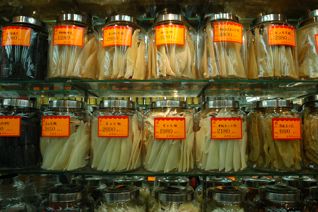
The campaign against shark-fin soup is building in Hong Kong and perhaps this is a good moment to summarize some of the actions and challenges around educating consumers about this unsustainable dish.

Recently, Legislative Council member, Hon. Audrey Eu, requested the moribund Hong Kong government to clarify its position on serving shark-fin soup at official banquets and to release information about how often the dish was included at state functions.

She also asked the government whether or not it was educating the public about the ecological damage caused by excessive consumption of high-value shark fins, which are often hacked off the still-alive marine animals. The shark body is then discarded in a practice widely condemned for its wastage and banned in U.S. and other waters.

The predictable response from Secretary for the Environment, Edward Yau at a Legco meeting on January 12 was that because of budgetary constraints not much shark-fin soup was served at official functions but that detailed information on this was impossible to gather. “We do not think it is appropriate to lay down guidelines to regulate the kind of food to be consumed in official banquets and meals,” Yau said.

Further, Yau hid behind the traditional government line, which is that HK follows CITES, which allows the trade in all 468 shark species (Yau says there are 320), except the three listed in the CITES appendices, Great White, Basking and Whale Sharks. “At present the laws of Hong Kong regulate the trade in shark species in accordance with the CITES requirements,” he said.

CITES is the Convention on International Trade in Endangered species of Wild Fauna and Flora.

The Hong Kong government showed once again that officials are more concerned with keeping an industry or trade body happy, in this case the Marine Products Association, than in any action against ecological damage or move toward encouraging sustainable fisheries.

Echoing this sentiment, in a recent letter to the SCMP, Robert Jenkins, identified as president of Species Management Specialists and apparently also a consultant to the Hong Kong Marine Products Association, wrote  “There are no valid reasons for Hong Kong’s Department of Agriculture, Fisheries and Conservation to condemn traditional Chinese cuisine simply to satisfy the views of persons and organisations ideologically opposed to human use of marine species for food.”

As justification for this he points again to CITES, which has 180 sovereign states as members and “for 25 years has been the premier international legal instrument identifying wild animals and plant species endangered by trade.” Even for the three listed shark species, Jenkins points out, CITES requires trade to be regulated, not stopped.

The reality is, however, that CITES is primarily a trade rather than a conservation body and as such is inherently political, motivated by issues beyond protection of species. CITES last year at its Doha meeting failed to include a severely threatened shark species, the Scalloped Hammerhead, among its appendices because member states with specific interests were  unable to reach agreement.  Even critically endangered Blue Fin Tuna is not listed by CITES.

Yet the International Union for the Conservation of Nature Red List of Threatened Species, has classified 143 shark species as either critically endangered, endangered, vulnerable, or near threatened with the risk of extinction. That amounts to 30 percent of all shark species and many of the shark fins that we find in Hong Kong markets actually belong to these.

Still, action against the consumption of shark-fin soup is growing in Asia. Illustrating the reputational risk to companies ignoring the issue, shark conservation organizations were again successful in pressuring a Hong Kong bank to withdraw a shark fin soup promotion. Last summer, following similar pressure, Citibank Hong Kong withdrew a shark-fin soup promotion and asked its employees to avoid the delicacy during work events.

Working together, several marine conservation groups recently launched a campaign against Dah Sing Bank  for announcing it would offer a shark-fin soup banquet for 12 to new borrowers.

After a few days of intense adverse publicity, the bank withdrew the offer. Hopefully, other financial institutions locally will also recognize the reputational risk around promoting or even serving shark fin soup at banquets.

Just to recap the importance, shark populations worldwide are facing massive decline. Scientists estimate that the fins of tens millions of sharks are traded globally.   This is devastating to sharks, which are slow-growing, long-lived, late to reach sexual maturity and produce few young.

In other words, the human appetite for shark fin and other shark products simply cannot be sustained.  The consumption of shark-fin soup is a major factor in declining shark populations, with potentially disastrous impacts on the entire marine ecosystem.

Although shark fins are widely regarded as tasteless, shark fin soup is considered a delicacy mainly because of the high price of the fins.  People eat or serve it mostly as a measure of status and a bowl can cost as much as US$400 a bowl.

Shark fins fetch a high price , while shark meat does not. Fins sold in Hong Kong range from about 90 euros to 300 euros per kilogram while shark meat in European markets fetch 1 euro to 7 euros per kilo, according to a Jan 22 letter to the editor in the South China Morning Post written by Claire Garner, director of the Hong Kong Shark Foundation (www.hksharkfoundation.org).

That means the  wasteful practice of shark finning – the cutting off a live shark’s fins and then throwing the body back to the sea – is highly lucrative.

WWF and other conservation organizations in Hong Kong such as Bloom Association, the Hong Kong Shark Foundation, Green Sense, Greenpeace, Shark Savers and others are working in their own way to draw attention to the need to protect sharks.

WWF has managed to persuade many corporations in Hong Kong such as HSBC, the Hong Kong and China Gas Company, Hang Seng Bank, Swire Properties, University of Hong Kong, Canon Hong Kong to adopt a no-shark-fin dining policy ( http://bit.ly/dtkHA1 ).  Hong Kong Observatory, and 180 primary and secondary schools also have made a similar pledge.

So what can the average person do to promote awareness around the damage shark finning causes our marine ecology? Beyond not consuming shark fin soup yourself, please do ask your companies and trading partners about their own policies.

It is urgent we act against waste and move consumption toward sustainable fisheries before it’s too late!

Greenpeace last week released the results of its third-annual green electronics survey – a look at how leading electronics manufacturers companies are doing. All but Apple and Phillips of the 21 companies contacted agreed to be ranked on three criteria; removing toxic substances, responsible take-back of their end-of-life products and energy efficiency.

The survey was motivated by the fact that throughout a product’s lifecycle – from material extraction to production, and from consumer use to disposal – electronic products have the potential to impact human health and the environment through the release of dangerous substances and energy consumption.

China is the world center for processing IT products and that country’s environment is paying the price. Printed Circuit Board and battery power production especially create heavy metal pollution.

Part of the problem is consumer demand for cheap products that don’t reflect the true cost of production – they don’t reflect the toll on the environment, on public and worker health.

Furthermore, IT companies continue to produce goods that have obsolescence built in, which means we consume endlessly looking for the newest or better product, boosting company revenues but at huge environmental and social cost, that, again, is not reflected in the price we pay.

The Greenpeace survey found a general improvement in green features compared to the previous two surveys in 2008 and 2007, including a significant decrease in use of hazardous chemicals and almost all products met or exceeded energy efficiency standards.

But lifecycle management was still the weakest point, with very little use of recycled plastic, varying take-back practices and few marketing efforts to prevent fast obsolescence of products.

Generally, also, Greenpeace found that electronics companies were becoming more transparent in the amount and type of product information provided to customers, often listing product’s chemical make-up and performance details.

Apple and Philips, however, once again refused to disclose any information to Greenpeace. Of course this reluctance to provide information is disappointing and not limited to probing by Greenpeace.

Beijing-based IPE, led by environmental activist Ma Jun, has also over the past year focused on the IT sector for its significant contribution to environmental degradation in China.

IPE has also contacted electronics companies about environmental violations and Apple is among those refusing to address questions about noxious emissions by factories producing its products.

Writing in a Guardian blog earlier last year, Ma Jun said 34 Chinese environmental organizations, including Friends of Nature, the Institute of Public and Environmental Affairs, and Green Beagle, questioned heavy metal pollution produced by companies in Apple’s supply chain in a letter sent to CEO Steve Jobs. Last week Ma Jun said that the only response from Apple has been a demand for proof that the polluting factories are producing electronics for Apple.

“The links between these companies and Apple are clearly established,” Ma Jun said last week. “We are working now to provide the company with hard evidence. Their unwillingness to release information about their production processes reminds me of Nike in the 1990s,”

By contrast, in an interview with Asia Water Project last year Ma Jun praised Hewlett Packard and Samsung for duck disclosure and movement toward greener products. Indeed, HP and Samsung were among the companies singled out in the Greenpeace survey for the producing some of the greenest products.

Why single out Apple, as IPE has done? Does a company with a solid reputation for being on top of its game, for producing innovative, quality and well-designed products, have a responsibility to manufacture without excessive environmental and social cost? Shouldn’t Apple be a leader also in its production processes and not a laggard?  Should we as consumers not demand more from the companies that sell us our products?

Fortunately, consumers ARE beginning to taking note. Companies that fail to adapt are poised to suffer huge reputational and revenue losses as a consequence.  A game-changing opportunity awaits those companies that choose to meet this challenge.


We recently hosted a forum with the Asia Foundation on Philanthropy and Climate change.  We hoped to encourage Asian funders to draw the lines between climate change (something that seems often hard for the individual to grasp) and the more tangible and immediate air pollution, forestry degradation, water scarcity etc.

We also hoped to then get them to think beyond the environment to a wider philanthropic portfolio and to consider the impact of climate change on livelihoods, health, education – even how funders in the arts might get involved to build awareness around the need to act.

Why? We feel that given the enormity of the problem, it’s often hard for the individual funder, the family office foundation, to see how they might act in any way that is impactful.

But what we found was remarkable energy in the room. Rather than despair, we felt that participants left informed and energized by our panelists and keynote speaker, Stephen Heintz of Rockefeller Brothers Fund, which has an excellent environment and health, southern China program, managed by Shenyu Belsky.

Dr. James Hansen, one of the world’s leading climate scientists and head of the New York’s NASA Goddard Institute for Space Studies, provided an overview of climate science – setting the scene for discussion. Dr. Hansen, an advocate for a carbon tax, spoke of our inertia in the face of an emergency, the possible extermination of species, receding glaciers, bleaching of coral reefs, acidification of the ocean, basically that we are a planet out of balance.

Heintz also spoke about urgency, describing climate change as a “planetary threat that knows no bounds.” He emphasized the particular threat in Asia – that of 16 countries facing extreme risk, five are in in this region and they are among the most impacted, low-lying Bangladesh for example.

In all, he said, global warming could cost southeast Asia 6-7 percent of GDP. Clearly, Asia is squarely at the intersection of climate and development and he emphasized the need for new ideas and new ways of thinking, something that accurately reflects current realities and anticipates new needs.

It is easy, Heintz pointed out, to be discouraged by the science, yet philanthropy, government, civil society and the private sector all have roles to play. In reality , it is imperative that we act because, inevitably, climate change will impact every other issue that we are working on.

Global grant-making, Heintz said, has increased dramatically over the past decade yet environmental issues are way behind, receiving only 5 percent of funding. Resources targeting climate change specifically, of course, are far less.

The philanthropy sector, Heintz said, can play a crucial catalytic role, take risk, experiment, support advocacy to change public policy and trigger larger systemic change. Important will be innovative public-private partnerships, helping to develop emerging models of low-carbon prosperity. His was an excellent speech.

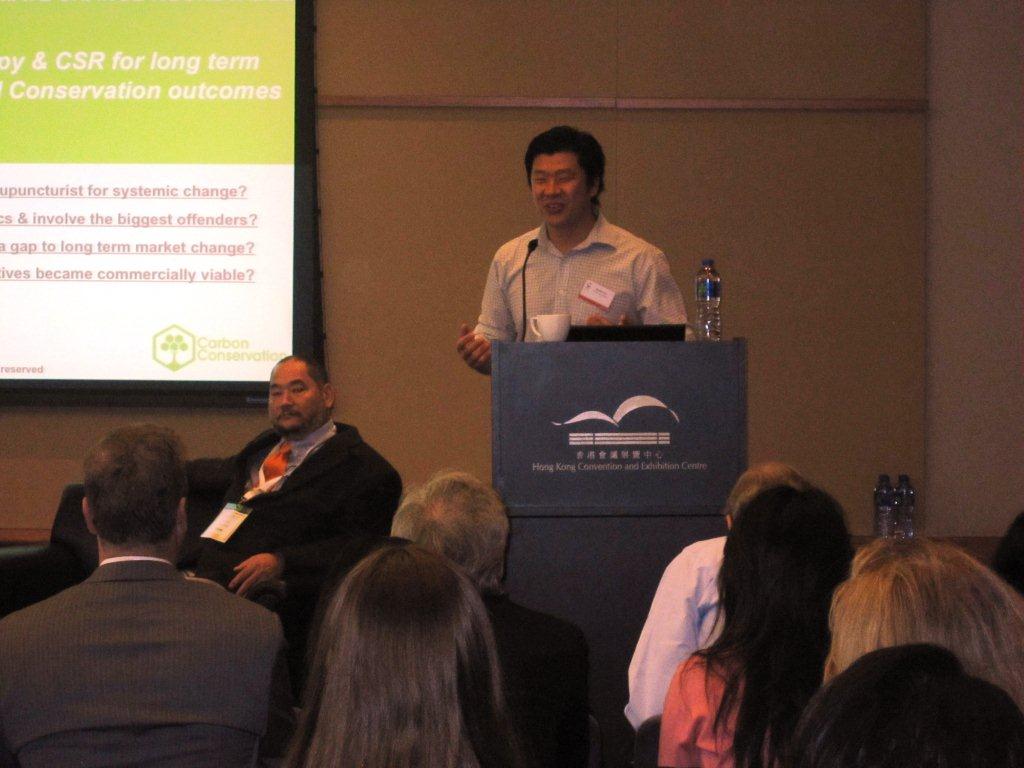
Our three panelists, Runa Kahn of Bangladesh’s Friendship, Dorjee Sun of Carbon Conservation and John Liu, an environmental filmmaker and journalist based in Beijing, spoke of the practicalities of working effectively within this context – and they also were inspiring.

Runa spoke about making life possible for the 4 million people living  in impossible circumstances in Bangladesh’s northern chars, John Liu on a massive ecological restoration project in China and showed the results, Dorjee on carbon, community and market solutions for saving forests.

The entire session was expertly moderated by the Asia Business Council’s Mark Clifford who managed to draw together the discussion, keeping an often amorphous and difficult topic moving toward practical solutions and away from fear.

The forum was a private side event to the C40 Climate change conference early this month organized by the Civic Exchange and supported by the Hong Kong government and Jockey Club Charities Trust.

It would be great to hear about other experiences linking climate change with a wider philanthropic portfolio, about nudging funders into action in this arena.

With air pollution at critical levels, the Hong Kong government fails to act to protect public health. After years of study, public consultation and dithering over what to do, there still is no action to revise air quality objectives, last rewritten in 1987.

Continue Reading...
Mountains of garbage in Mumbai

Mountains of waste


We hear about climate change all the time now, we know it’s bad, we understand much of the science behind the phenomenon. But what can we do? No really, what CAN we do? How does this broad concept connect with our daily lives? 

We turn off and unplug appliances, we try to take public transport where possible, we use fewer resources, turn down the air conditioning in summer and heat in winter, we buy less bottled water. 

But often we don’t stop to think about the rest of our lives. We still want to eat strawberries in winter, meat flown in from the U.S. We (or our children) still buy clothes where often quantity and price reigns over quality. 

We look for lower prices (because we’re hooked on cheaper is better) and then don’t have to think so hard about whether or not that particular cheap item that clearly is not taking into account the environmental or social cost of  production is actually needed.  

We change our cars regularly, buy the latest Apple gadget (must have the ipad, the latest computer to stay in touch) and think nothing of chucking an iphone, ipod that has lasted only a year. 

What happened to the time in the not so distant past when we romanced a dress for a long time and just one purchase was ok, when we could buy fresh local produce and meat in season, when one car lasted a decade or more, when we didn’t need gadget upon gadget to be happy?    

So back to climate change: All of that consumption, flying goods around, needs energy. Production and energy (produced largely by coal in China) at least at the moment lead to air pollution and climate change. Sometimes we forget the connections. 

 In Hong Kong this week Clean Air Network has been good to remind us  with its tongue-in-cheek Fresh Air video what we face if we don’t change our bad habits:  http://www.youtube.com/watch?v=lmH3xCpOSW8

Hong Kong’s air quality is among the world’s worst for a city of comparable income levels. Here, the pollution we breathe negatively affects everyone. Not surprisingly, the poor are disproportionately impacted because they are unable to move out of some of the city’s most congested, polluted areas.

Since 1987, the World Health Organization has issued Air Quality Guidelines (”AQG”) to help governments protect public health. These AQGs are periodically revised to take into account the latest scientific research on the health impact of bad air. Currently, however, Hong Kong’s Air Quality Objectives (“AQO”) permit emissions that exceed the WHO’s latest AQGs by two to four times.  The AQOs, which are non-binding, were last updated in 1987. This year, the Government is reviewing the AQOs for the first time in more than 20 years.

Over the past two decades there has been insufficient action to mitigate air pollution in Hong Kong. We have often heard from government officials that there is little that can be done to change the quality of our air because much of the pollution drifts across the border from Guangdong.

Yet, research by the Hong Kong University of Science and Technology has shown that 53% of the time (192 days per year in 2006), most pollution affecting Hong Kong is from LOCAL SOURCES.

Some alarming facts about Hong Kong air pollution:

  • By WHO standards, Hong Kong’s air is only safely breathable 41 days a year.
  • Hong Kong air pollution causes three (avoidable) deaths a day, or more than 1,100 per year.
  • Hong Kong’s air is three times more polluted than New York’s and more than twice as polluted as London.
  • Although overall emissions tonnage has fallen in the past 15 years, roadside pollution has not improved. Because of its high concentration in close physical proximity to us, roadside pollution poses the biggest threat to human health.
  • 40% of roadside emissions come from buses.

It is therefore incorrect to believe that Hong Kong-based pollution abatement measures would make no or little difference in improving the local air quality.

We believe the Government could and should act immediately to improve the quality of air we breathe. Many cities worldwide have successfully taken action to clean their air and we believe that with tight AQOs and an appropriate plan of action could similarly clean up our air and improve the lives and health of residents

The Clean Air Network (www.hongkongcan.org) was formed to educate the public about the health impacts of air pollution and mobilize support for clean air in Hong Kong.

CAN is a NETWORK, bringing together and amplifying the voices of individuals, groups and organizations.

CAN’s overarching goal is to work with the Government to implement a stricter and more proactive air quality management regime.

Watch the CAN video here: http://bit.ly/86Md2r

.