Archives For November 30, 1999

Mountains of garbage in Mumbai

Mountains of waste


We hear about climate change all the time now, we know it’s bad, we understand much of the science behind the phenomenon. But what can we do? No really, what CAN we do? How does this broad concept connect with our daily lives? 

We turn off and unplug appliances, we try to take public transport where possible, we use fewer resources, turn down the air conditioning in summer and heat in winter, we buy less bottled water. 

But often we don’t stop to think about the rest of our lives. We still want to eat strawberries in winter, meat flown in from the U.S. We (or our children) still buy clothes where often quantity and price reigns over quality. 

We look for lower prices (because we’re hooked on cheaper is better) and then don’t have to think so hard about whether or not that particular cheap item that clearly is not taking into account the environmental or social cost of  production is actually needed.  

We change our cars regularly, buy the latest Apple gadget (must have the ipad, the latest computer to stay in touch) and think nothing of chucking an iphone, ipod that has lasted only a year. 

What happened to the time in the not so distant past when we romanced a dress for a long time and just one purchase was ok, when we could buy fresh local produce and meat in season, when one car lasted a decade or more, when we didn’t need gadget upon gadget to be happy?    

So back to climate change: All of that consumption, flying goods around, needs energy. Production and energy (produced largely by coal in China) at least at the moment lead to air pollution and climate change. Sometimes we forget the connections. 

 In Hong Kong this week Clean Air Network has been good to remind us  with its tongue-in-cheek Fresh Air video what we face if we don’t change our bad habits:  http://www.youtube.com/watch?v=lmH3xCpOSW8

In Hong Kong we rightly complain about the state of the air we are forced to breathe and the government’s apparent lack of interest in addressing the pollution challenges – despite  HK$ half-trillion in fiscal reserves this year.

The moribund HK government seems incapable of taking action to protect its citizen’s health despite having the financial resources to do so. Clean Air Network is working hard and successfully to educate the public and stir the government to act, providing the tools and support to do so – hand-holding of sorts.

But perhaps part of the challenge is that in Beijing, from where I am working for three weeks, Hong Kong’s pollution pales by comparison – not that this city should set any standard!

Here, my eyes are a constant rimmed-red, a smog headache challenges concentration and my sinuses are in revolt. Here, the clouds are but a memory and weather is either cold or hot but never sunny, it seems, but there is only a steady grey. The near distance fades into a smog that anywhere else would be unbelievable.

This is the price of China’s progress, and, to be fair, of pulling an estimated 600 million people out of poverty over the past two decades by fulfilling our Western need to consume ever-more products. According to the ADB, over the past 20 years, China’s poverty rate fell from 85% to 15.9% – a huge challenge for any government and unmatched anywhere, anytime.

Still, what we hear more about in the West is the fantastic progress machine that is China, the well-oiled production centre for the world’s consumers.

The flip side of that for China’s citizens is the polluted rivers, the smog-filled air, the cancer villages in evidence countrywide, the drained aquifers, the contaminated land. All of these will be the Beijing government’s newest challenges if it is to keep its population healthy and maintain social stability, which is the utmost goal.

Highly polluted areas near factories have shown increasing cases of cancer.  Southern China is replete with communities that recycle electronic waste and here people are exposed to toxic heavy metals such as cadmium and mercury.  The country’s myriad chemical factories produce carcinogens that enter the water and soil, also contaminating food grown on the land.

According to a recent Guardian article, in 2007, cancer was responsible for one in five deaths, and Chinese farmers are more likely to die of liver and stomach cancer than the world average.

Water supplies are polluted and aquifers significantly drained, something leading environmental activist Ma Jun warned about ten year’s ago in his book, China’s Water Crisis, which considered the local equivalent of Rachel Carson’s Silent Spring.

The Qinghai-Tibet plateau area suffers from environmental degradation that is threatening three major rivers: the Yangtze, Yellow and Mekong. Melting permafrost and glaciers in the surrounding mountains are also eroding the grasslands and wetlands, causing the ground to lose its capacity to absorb water, according to AFP.

Xin Yuanhong, a government scientist quoted by the news agency says that at the current rate, 30 percent of the region’s glaciers could disappear within 10 years.

Climate change is also affecting the 580 million people living in these river basins.  This crisis also affects food security; drought and drying up water sources are severely lowering crop yields in the area.

By all accounts, the government increasingly understands the severity of the challenge. Careful Chinese environmentalists are being allowed to speak out. Indeed, many seem to be encouraged by the government to highlight bad practice by companies breaking local laws by emitting pollutants into the water, air and ground. Information disclosure has taken leaps forward in recent months.

Ma Jun and his Institute of Public and Environmental Affairs over the past several years have divulged information in online databases of air and water violations by factories throughout China. He has created a groundbreaking “blacklist” of polluters. At last count, IPE databases listed more than 60,000 air and water violations.

To be removed from the list, companies must take corrective action and accept IPE-supervised environmental audits of their Chinese factories. Ma is also a champion of increasing access to environmental information, which he believes will bring public pressure on companies to operate more responsibly.

In Yunan Province, Yu Xiaogang, another courageous environmentalist I met with recently, is also using information disclosure, to gain bank data. He and his group, Green Watershed, along with a network of nine other NGOs, are compiling information on loans granted to development projects that are damaging to local populations.

The group recently published the environmental record of 14 Chinese banks, looking at their policies, regulations, investments and loan portfolios, noting which were connected with environmentally damaging projects.

Yu is also working with communities to help them open channels with local financial institutions to discuss social and environmental impact ahead of any loan being granted to a large development initiative.

That Beijing seems to be backing the sort of discussion underway in China is certainly encouraging. It seems Hong Kong should be setting standards in the environmental arena not lagging behind its severely challenged neighbour.

Babirusa

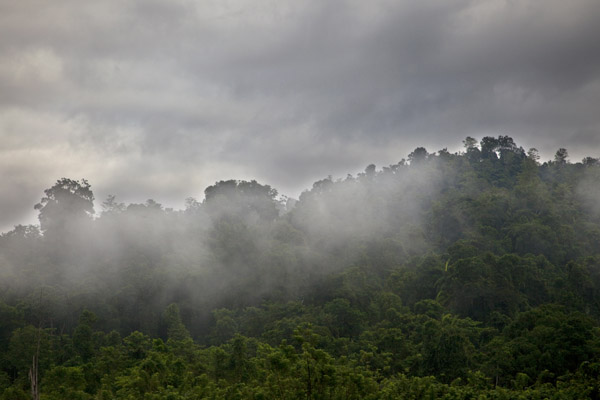
If I were a pessimist, this might be a moment of total despair over the future of high conservation value tropical forests in Indonesia.

The question we and others have struggled with has been: how to make the economics work for conservation? Logging is profitable business for large landowners; for communities, cutting trees can often represent the only source of income.

Most recently, hopes have rested on the carbon markets and REDD as a source of funding for both communities and landholders, paid for by companies wanting to offset their carbon emissions.

But Copenhagen was a disaster, leaving little hope for any global carbon framework anytime soon, while the weak U.S. Climate Change bill looks like it won’t be up for debate this year.  The carbon markets are in disarray.

Meanwhile, climate science itself is embroiled in controversy over seemingly not very much and last year’s financial markets meltdown has made investors innovation adverse.

When one of our carbon champions returned last week from a tour of the U.S. seemingly distraught over the state of the markets, we knew that was at least not an immediate answer to funding conservation, despite the abundance of REDD carbon projects dotting Southeast Asia!

But what are the solutions? What can possibly compete with the huge profits from logging virgin forests?

For two years, we have been working with Oxford-educated biologist, Dr. Lynn Clayton, who for the past two decades has courageously worked to protect the 62,000-hectares Nantu forest in Sulawesi, Indonesia.

Working with a small team, Dr. Clayton has done an excellent and recognized job keeping hunters from the region’s many endemic species such as the babirusa and anoa, which are described  in Alfred Russell Wallace’s 19th century tome, the Malay Archipelago, which chronicles the naturalist’s journeys in the unique region.

Under consideration has been an off-shore trust fund that would generate resources to support the conservation effort at Nantu and at the same time help promote alternative livelihoods for local communities, which are vital to any such effort.

But trust funds, which involve sizable up front chunks of cash, have fallen out of favour in the rush to carbon thus raising those sorts of resources (we estimate that US$5 million in a loan or donations would help secure Nantu) has proven difficult.

With carbon less certain than ever, the other alternative has been to generate business models around Nantu that potentially could generate funding for conservation as well as support local livelihoods.

Once again, however, the sticking point seems to be the feasibility studies and business planning that involve significant upfront costs with uncertain returns. What are interesting conservation finance models, perhaps from other regions, that are working?

Most of us agree that deforestation on the scale we have seen in recent decades is undesirable and unsustainable.

Our tropical forests are in dramatic decline, pumping tons of carbon into our atmosphere and causing changes in temperature and rainfall worldwide with potentially devastating consequences for our planet.

The problem remains, how to tackle this critical problem in developing regions, where corruption is endemic, how to pay the enormous costs of protecting forests and engaging the local communities that depend on them for their livelihoods.

Reversing global deforestation will require industrialized countries to invest billions annually in forest protection. It is worth remembering, however, that last year U.S. government put aside $700 billion for banks, insurers and automakers during the financial crisis as part of the Troubled Asset Relief Program.

By now, we know the story: Rainforests soak up huge amounts of planet-warming carbon dioxide. Deforestation releases retained CO2 released into the atmosphere.  Forest destruction contributes about 20 percent of mankind’s greenhouse gas emissions annually, according to the U.N. climate panel. Indeed, tropical deforestation is more damaging to our planet than the transport sector or factories, with one day of logging equivalent to the carbon footprint of eight million people flying to New York.

And why do we care? Our rainforests form a vital cooling band around the earth’s equator, generating a large part of our rainfall and acting as a thermostat.  We perhaps also aren’t aware that 50 per cent of life on earth exists in these humid forests, which cover less than 7 per cent of the planet’s surface. We are far from understanding the real consequences of losing the biodiversity we seem to take for granted.

Yet our governments, and indeed most of us, continue to act as though our tropical forests are expendable, that there is no impending climate crisis, biodiversity is a given, perhaps unimportant, and anticipate little, if any alteration in our lives of consumption and energy use.

Clearly, December’s global climate powwow in Copenhagen was the best reflection of this, with no real sense of urgency conveyed by governments gathered there.  Country delegations arrived by private jet, were ferried around town in gas-guzzling limos – not exactly the right tone for a crisis meeting on climate.

There had been hope to gain a legally binding international treaty committing nations to mandatory cuts in greenhouse gases but none was forthcoming, lost once more in the all too familiar regional bickering. And chances are slim of any agreement from the next round of U.N. climate talks in Cancun, Mexico, particularly following the resignation last week of Yvo de Boer, who has led the process for four years.

The pledges that de Boer did manage to eke out of Copenhagen will merely stabilize emissions by 2020. By most accounts, we need to achieve reductions  of at least 50 percent by midcentury – something that can’t be achieved without big cuts from the major emitters, which are the U.S., China, India and Brazil.

Part of the problem lies in ascertaining, at the international level, who should pay to conserve our forests. Developing nations want the right to develop unimpeded, while the United States wants to see significant emissions cuts from China and India that would be on par with its own and doesn’t want to be held accountable for cost.   Fundamentally, the U.S. has no effective national strategy of its own and thus is really not in a position to take the lead.

The assumption is that at some point, nations will get it together to achieve meaningful emissions reduction and carbon will become a real part of the solution. In the meantime, regional initiatives such as the U.S. Climate Change legislation currently stalled in the U.S. senate are evolving and could bring some movement in the carbon picture, generating resources for forestry conservation.

But will this be too little too late for our forests and what is the solution for them while we wait?

The bottom line is that in an attempt to protect what is left of our precious stores of tropical timber and the estimated 1.6 billion people who live amongst them, environmental groups have poured tens of millions of dollars into conservation over the last two decades without any real gains.

Global Witness co-founder Patrick Alley, said in a worth-quoting speech last year :

Virtually every intervention by the international donor community into the forests sector over the past few decades costing hundreds of millions of dollars has essentially been to patch up the holes in enforcement to stop the haemorrhaging of illegal timber and corruptly looted revenues. And these interventions have ranged from certification, chain of custody systems, governance, capacity building, law enforcement and there has been precious little success in that litany. And on top of this, we have the increasing threats of conversion to plantations and agricultural encroachment http://bit.ly/fiCvz

The U.N.’s Food and Agricultural Organization says about 13 million hectares, or an area the size of England, are still destroyed annually. In all, half the world’s tropical and temperate forests are now gone.

Author and environmental advocate, Gus Speth, ( http://bit.ly/bSBjOR) pointed out in a recent speech that species are disappearing at rates about 1,000 times faster than normal in a spasm of extinction not seen in 65 million years, since the dinosaurs disappeared.

Changes in our rainfall patterns have meant that over half the agricultural land in drier regions suffers from some degree of deterioration and desertification.

A key concern, if we are to reverse this trend, is either how to pay for conservation or, alternatively, how to make conservation pay; at a national level, how to justify the loss of revenue for developing countries that need the income.

The sad reality is that logging in the tropics generates enormous profit, but not for local communities and mostly not for governments in the form of taxes. Instead, much of the profit finds its way into corporate coffers and the offshore accounts of connected local individuals through corruption and illegal practices. The profit pressures on forests are huge from these interests. Biodiesel and palm oil have now also entered the equation, adding to the strains.

One initiative that tries to address the question of  how to generate profit for conservation and formalized at the Copenhagen talks was a U.N.-backed forest protection scheme called Reduced Emissions from Deforestation and Degradation or REDD.

This would include forests in the global carbon markets,  allowing polluters to earn tradable carbon credits by paying developing nations billions not to chop down their trees.  Local communities are supposed to earn a share of REDD credit sales to pay for better health, education and alternative livelihoods that persuade them to protect rather than cut down their forests.

But the revenue-sharing arrangements will differ for each country. Some NGOs worry that once again little support will filter down to the communities, with central and provincial governments demanding control of the money.

Another problem is that carbon measurement and accounting as part of any REDD design is complex and time-consuming, requiring laws to be enacted, officials to be trained and investors to be assured that the scheme won’t be undermined by corruption.

And finally, ensuring the forests aren’t simply cut down later, or that deforestation is displaced to another region or country, is another concern. REDD’s final technical design will have to address these issues.

Still, the well-regarded Eliasch Review (http://bit.ly/d99kM3) suggests that including REDD in a well-designed carbon trading system could provide the finance and incentives to reduce deforestation rates by up to 75 per cent in 2030

Still, in Indonesia, where the REDD discussion is quite advanced, there have been warnings that billions of dollars clearly are at risk from graft unless the country puts strong oversight mechanisms in place, according to a recent report released by CIFOR. (http://bit.ly/cfld28)

“Investors should be looking very carefully at the financial governance conditions in the countries where they will be investing their funds. Like Indonesia, many tropical forest countries have long track records of mismanaging public financial resources, particularly in the forestry sector,” said the report’s co-author, Christopher Barr.

Indonesia, which is one country in which ADMCF works on forestry issues, is the world’s third-largest area of tropical forest and the world’s third-largest emitter of carbon after the United States and China because of the massive destruction there of rainforest and peatlands.

Last year, Indonesia set up a legal framework for REDD. Several pilot projects are under way and the governments of Norway, Australia, Germany and the U.S. have promised millions of dollars in funding.

What we have seen everywhere forests are protected however, are the sad unintended consequences of the scramble for carbon: environmental groups that have been conserving forests are backing away from protecting them, fearing that as protected forest they won’t qualify under the REDD additionality clause.

It is uncertain whether already protected forests would qualify for REDD credits. This means that while we wait for REDD, for any sort of global or regional framework that will push forward the mechanisms that will allow large-scale protection, our forests are potentially more vulnerable than ever.

Hong Kong’s air quality is among the world’s worst for a city of comparable income levels. Here, the pollution we breathe negatively affects everyone. Not surprisingly, the poor are disproportionately impacted because they are unable to move out of some of the city’s most congested, polluted areas.

Since 1987, the World Health Organization has issued Air Quality Guidelines (”AQG”) to help governments protect public health. These AQGs are periodically revised to take into account the latest scientific research on the health impact of bad air. Currently, however, Hong Kong’s Air Quality Objectives (“AQO”) permit emissions that exceed the WHO’s latest AQGs by two to four times.  The AQOs, which are non-binding, were last updated in 1987. This year, the Government is reviewing the AQOs for the first time in more than 20 years.

Over the past two decades there has been insufficient action to mitigate air pollution in Hong Kong. We have often heard from government officials that there is little that can be done to change the quality of our air because much of the pollution drifts across the border from Guangdong.

Yet, research by the Hong Kong University of Science and Technology has shown that 53% of the time (192 days per year in 2006), most pollution affecting Hong Kong is from LOCAL SOURCES.

Some alarming facts about Hong Kong air pollution:

  • By WHO standards, Hong Kong’s air is only safely breathable 41 days a year.
  • Hong Kong air pollution causes three (avoidable) deaths a day, or more than 1,100 per year.
  • Hong Kong’s air is three times more polluted than New York’s and more than twice as polluted as London.
  • Although overall emissions tonnage has fallen in the past 15 years, roadside pollution has not improved. Because of its high concentration in close physical proximity to us, roadside pollution poses the biggest threat to human health.
  • 40% of roadside emissions come from buses.

It is therefore incorrect to believe that Hong Kong-based pollution abatement measures would make no or little difference in improving the local air quality.

We believe the Government could and should act immediately to improve the quality of air we breathe. Many cities worldwide have successfully taken action to clean their air and we believe that with tight AQOs and an appropriate plan of action could similarly clean up our air and improve the lives and health of residents

The Clean Air Network (www.hongkongcan.org) was formed to educate the public about the health impacts of air pollution and mobilize support for clean air in Hong Kong.

CAN is a NETWORK, bringing together and amplifying the voices of individuals, groups and organizations.

CAN’s overarching goal is to work with the Government to implement a stricter and more proactive air quality management regime.

Watch the CAN video here: http://bit.ly/86Md2r

.